Key Takeaways
- Foundation settlement is vertical movement tied to changing soil or support conditions, and minor movement is often tolerable.
- Uniform settlement is relatively even movement across the footprint; differential settlement means some areas move by different amounts or rates, which tends to create more distortion.
- Soil variability, compaction and fill, water and drainage, moisture swings, leaks, vegetation, and ground disturbance can all contribute, but no single cause explains every property.
- Cracks, floor slopes, operating changes, gaps, and water behavior are observations rather than proof by themselves. Pattern, sequence, and change over time carry more weight.
Foundation settlement describes a foundation moving downward as the supporting ground changes with time. A modest amount of movement is common in many buildings, but larger or uneven shifts can distort finishes and alter how doors or windows operate. The sections below explain how engineers use the term settlement, what conditions often influence it, how to document what you observe, and broad categories of responses you may hear discussed. It is general education, not a site-specific diagnosis, geotechnical report, structural evaluation, foundation repair specification, safety clearance, insurance conclusion, financial recommendation, or contractor recommendation.
What Is Foundation Settlement?
Settlement as Downward Movement
People typically use the phrase settling foundation to describe downward movement of a structure as the ground responds to load or moisture changes. Soil is a mix of minerals, water, and air. As that mix shifts, support can compress or redistribute, and the foundation may move. Settlement concerns vertical movement under gravity; it is distinct from sideways sliding of the entire building.
Small amounts of movement are common and often benign. The bigger concern is differential movement, in which one part of the building shifts differently than another and the structure deforms to accommodate it. You might then see cracking or doors out of alignment. Even so, visible signs are not a diagnosis by themselves. Timing, context, and whether features are progressing are central to interpretation.
Immediate, Consolidation, and Secondary Settlement
Engineers often break settlement into three components. Immediate settlement is the quick, largely elastic shortening of the soil–foundation system that happens soon after loading. It may occur during or shortly after construction as soil compresses beneath the new weight.
Consolidation settlement occurs more slowly as water is driven out of certain saturated soils under sustained load. Secondary settlement, also called creep, is very gradual deformation that unfolds over longer periods. These ideas explain why some movement appears early while other changes develop over years, but they are not predictions for any particular property.
Uniform Settlement, Differential Settlement, and Rotation
Uniform settlement means the structure drops by a similar amount across its footprint. A building can remain internally level even if it now sits slightly lower relative to the yard. Because alignment is preserved, uniform movement often causes fewer interior problems.
Differential settlement happens when one area moves more, or moves more quickly, than another. That mismatch introduces bending and twisting. Walls or slabs may crack as the structure adapts to uneven support. Rotation is a related effect in which a footing or wall tilts along its length, altering alignment. These patterns are more likely to create visible distress, which is why distinguishing uniform from differential behavior matters.
Potential Causes of Foundation Settlement
Soil Type, Compressibility, and Variable Support
Soil is not uniform even across short distances. Layers can differ in density, grain size, and sensitivity to moisture. Some soils compress readily under load, while others are comparatively stiff. If a footing crosses from a firm layer into a softer one, each portion can respond differently, leading to differential movement.
Natural variation can also include buried organics, old root paths, pockets of debris, or remnants of prior excavation. Those features can consolidate or decay over time, changing local support. Where loads are concentrated on a small area, stresses increase, and the local response can be greater.
Compaction, Fill, and Disturbed Ground
Many sites contain placed fill to create a level pad, backfill around walls, or trenches for utilities. If that fill was not compacted adequately for anticipated loads, it can compress and settle later. Even well compacted soils can relax slightly after disturbance, particularly if they become saturated or dry out markedly.
Transitions between native ground and placed fill often create variable support. Utility trenches, voids from removed stumps, and pockets of loose soil behave differently than surrounding ground, making them common starting points for differential movement.
Water, Drainage, Erosion, and Subsurface Leaks
Water changes how soils support load in several ways. Saturation can reduce strength and increase compressibility. Flowing water can transport fine particles away, slowly eroding support beneath slabs or footings. Poor surface grading, clogged gutters, short downspouts, and low spots along the foundation encourage repeated wetting that alters soil behavior.
Subsurface leaks from supply lines, irrigation, or drains can create soft zones or washouts that may not be obvious at the surface. Over time, softened soil and migrating fines can lead to localized downward movement. Managing water exposure can reduce risk, but it does not by itself determine whether settlement has occurred or whether structural stabilization is appropriate.
Groundwater fluctuations and seasonal precipitation patterns also matter. Extended wet periods can increase consolidation in some layers, while rapid drying can shrink moisture-sensitive soils. The net effect depends on soil type and site geometry.
Moisture Variation, Drought, Vegetation, and Expansive-Soil Context
Certain clays change volume markedly with moisture content. Drying can shrink soil and reduce support, encouraging downward movement. Wetting can cause swelling and, in some contexts, upward heave. Both processes can damage finishes and affect alignment, but settlement refers specifically to the downward component.
Landscaping and irrigation influence moisture near foundations. Large trees and shrubs can extract water from zones that extend below footings or slabs. Drought can intensify that drawdown, especially if irrigation is reduced. Conversely, adding irrigation or directing roof runoff toward the house can push moisture the other way. On moisture-sensitive sites, steady, moderate water practices are safer than abrupt shifts.
Excavation, Loading, and Site Changes
Post-construction changes can affect load paths or ground conditions. Examples include adding a heavy fireplace, installing a large water feature, regrading for a driveway, or excavating near a footing. New loads can compress soils further, and nearby cuts can remove lateral confinement that previously helped resist deformation.
Construction vibrations, frequent heavy vehicle traffic close to the structure, or demolition next door can disturb the soil fabric. While a single brief event is often inconsequential, repeated or combined changes can alter how the foundation and ground interact over time.
Signs That May Appear With Foundation Settlement
Cracks, Gaps, and Masonry Changes
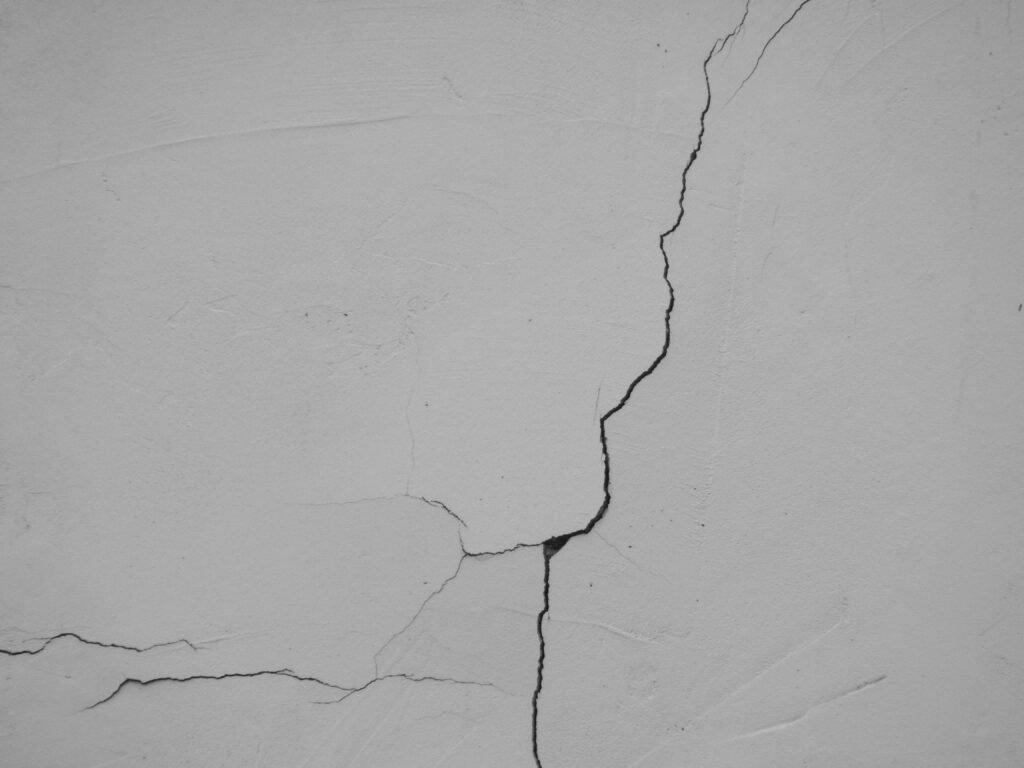
Cracks are among the first things homeowners notice. In masonry, stair-step patterns along mortar joints may form as a wall distorts. In framed houses with brick veneer, small gaps can open where veneer meets trim. Inside, drywall may show diagonal or vertical cracks at corners, above openings, or where framing changes occur. Hairline drying cracks can be unrelated to movement, so pattern, location, and progression matter more than width alone.
Separation lines often appear where porches or additions meet the original structure. A consistent gap is not necessarily proof of settlement because different parts of a house can move differently simply due to how they are built. Dated photos and repeated measurements help show whether change is ongoing.
Doors, Windows, and Interior Alignment Changes
Movement can alter how openings operate. Owners may see latch misalignment, striker plates that miss, or doors and windows that bind at specific points. Trim can develop tapered gaps where it once fit evenly. Humidity swings, frame warp, and hardware wear can produce similar behavior, which is why sequence and related signs matter.
Interior alignment clues include cabinets that appear to lean, counters that no longer meet backsplash tile evenly, or baseboards with uneven reveals. One sticky door is less informative than a consistent group of symptoms that fit a clear movement pattern.
Sloping or Uneven Floors
Floors may slope or feel uneven when supports move at different rates. In wood-framed homes, joists follow the movement of beams or bearing walls, creating a subtle roll. In slab-on-grade homes, the slab itself may become uneven as the ground responds. These sensations are often more noticeable near transitions between original construction and later additions or infill areas.
Seasonal variation can be telling. If slopes shift with wet and dry periods, moisture-sensitive soils might be involved. A slow, steady trend may point toward long-term consolidation. Neither observation proves a cause, but each helps frame questions for evaluation.
Chimneys, Porches, Steps, and Exterior Separation
Chimneys and masonry columns are heavy and comparatively rigid, which makes them responsive to variable support. A leaning stack, widened mortar joints, or a gap where masonry meets siding are common observations. Porch slabs and exterior steps often rest on shallow support or fill and can move independently from the main foundation, sometimes creating the impression that the house moved when the accessory element is the one that settled.
Look for relative movement. If the main wall remains plumb while the porch has dropped at the outer edge, that is a different condition than a wall and porch moving together. Distinguishing accessory slab settlement from primary foundation movement helps avoid confusion.
Moisture, Ponding, and Soil Clues
Water behavior near the building offers useful clues. Persistent ponding along the foundation, downspouts discharging at the base of walls, or rills carved into planting beds indicate repeated wetting. Soil that turns to mud after modest rain suggests poor drainage, while crusted, shrinking soil with open surface cracks during dry periods points to significant moisture swings.
Stains on concrete, efflorescence on masonry, or soft turf patches can indicate leak paths or chronic saturation. These details inform exposure conditions but, by themselves, do not prove settlement.
Foundation Settlement Versus Other Forms of Movement
Settlement Versus Upward Heave
Settlement is downward movement tied to reduced support or compression of soils. Heave is upward movement driven by swelling soils, frost in cold climates, or other volume increases. Both can create cracks and misalignment, yet direction and seasonal timing often differ. For instance, expansive-soil heave may peak after wet seasons, while drying tends to contribute to downward movement.
Because symptoms overlap, identifying direction is important before discussing evaluation and possible responses. The same crack pattern can arise from different mechanisms in different contexts.
Foundation Support Versus Exterior Slab Settlement
Patios, walks, garage aprons, and steps commonly sit on separate, thinner slabs with shallow support. They can settle or heave without the main foundation moving at all. A crack or gap where an accessory slab meets the house may reflect an exterior-slab issue rather than a foundation problem.
Differentiating these elements sets priorities. A settling sidewalk may be a tripping hazard but does not necessarily indicate house movement. In contrast, consistent interior distortion can point toward foundation or interior support movement rather than a thin exterior slab.
Moisture Problems Versus Structural Movement
Moisture issues—such as basement leaks, damp crawl spaces, or efflorescence—affect durability and indoor air quality. However, water intrusion alone does not prove that the foundation is moving. Bulk-water control aims to keep water out or carry it away; structural stabilization addresses how the building is supported.
Reducing water exposure can limit further changes in soil conditions and lower risk, but it should not be confused with reversing movement that has already occurred. Keeping these topics separate avoids assumptions and clarifies objectives.
Why Similar Symptoms Need Different Evaluation
A diagonal crack near a window might result from differential settlement, seasonal moisture change, frame shrinkage, or even past repairs. Correct interpretation depends on location, crack geometry, timing, and related observations. Broad claims based on a single symptom can mislead.
Effective evaluation looks for patterns and weighs soil type, construction details, drainage, landscaping, and site changes over time. Homeowner documentation improves the quality of that assessment.
How to Document Foundation Settlement Concerns
Take Dated Photos From Consistent Views
Photos are most useful when you can repeat them. Choose a few viewpoints that capture the areas of interest and note those positions so you can return to the same spots. Include a recognizable reference—such as a ruler, coin, or door frame—for scale. Enable date stamps or keep images in folders labeled by date.
Capture both close-ups and wider context. A close-up records crack detail, while a wider shot shows how it relates to the full wall or room. Over time, these sequences reveal whether features are changing or holding steady.
Record Location, Direction, Timing, and Progression
A simple log helps bring order to observations. Note where an issue occurs, which direction the surface faces, and when you first noticed it. Add entries if anything changes. A written timeline is more reliable than memory.
If you measure, do it gently and consistently. For example, track whether a particular shim, card, or feeler fits a gap rather than forcing precise dimensions. Avoid chiseling, prying, or anything that could worsen the condition.
Track Water, Weather, Landscaping, and Utility Work
Because moisture and site changes influence soils, include rainfall events, drought periods, irrigation adjustments, gutter cleanings, and grading changes in your notes. Record any plumbing, sewer, or irrigation leaks and their repair dates. Mark when trees are planted, removed, or heavily pruned.
If you notice that conditions respond to seasons or storms, write that down. Correlating movement with water or weather helps frame questions about soil sensitivity and exposure.
What Professional Evaluation May Add
When requested, qualified professionals may use tools such as elevation surveys, crack monitors, or targeted soil assessments to understand patterns. These methods help quantify distribution and rate of movement when that information is needed. In some cases, limited exposures at select locations verify construction details or soil layering.
Foundation repair methods are chosen to fit the property and the questions at hand. A small, stable cosmetic crack does not warrant the same level of investigation as widespread alignment changes. The objective is clarity rather than a one-size-fits-all test package.
Managing Risk While You Seek Clarity
Keep Roof and Surface Water Away From the Foundation
Good water management lowers the chance that soils at the foundation will saturate repeatedly. Keep gutters clear and appropriately sized. Discharge downspouts well away from the base of walls using extensions or leaders to move water to lower ground. Maintain positive grading so surface water flows away from the structure.
These steps address exposure rather than structural stabilization. They reduce risk while you monitor and pursue evaluation, and they are part of sound home maintenance whether or not settlement is involved.
Investigate Suspected Plumbing Leaks Promptly
Leaks can undermine support by softening soils or washing out fines. If you suspect a supply, drain, or irrigation leak, prompt investigation is sensible. Even small, slow leaks can create localized soft spots over time.
Repairing leaks does not diagnose or correct movement that has already happened, but it prevents further soil disturbance from that source and can stabilize moisture conditions for more reliable monitoring.
Avoid Abrupt Water-Pattern Changes on Sensitive Sites
On moisture-sensitive soils, abrupt shifts in irrigation or landscaping can trigger volume change and movement. If you need to reduce or increase watering, adjust in gradual steps and watch how the site responds. Avoid concentrating roof runoff at a single point near the foundation.
Similarly, major landscape changes—such as removing large trees—can alter moisture balance. If such work is planned, include monitoring so you can identify any response early.
Know When Rapid Change Requires Timely Evaluation
Rapidly developing signs, such as quickly widening gaps, accelerating floor slopes, or a chimney that appears to move measurably over a short period, call for timely evaluation. A sudden change after excavation, a significant leak, or unusual ground movement also warrants attention.
Urgency is about rate of change and any safety concerns, not about a single crack or sticky door. When in doubt, pair documentation with a qualified assessment to reach clearer conclusions.
Repair-Category Context Without a One-Size-Fits-All Answer
Water Management and Drainage Work
Water-management work focuses on controlling exposure. Typical scopes include regrading to move surface water away, extending downspouts, adding area drains where appropriate, or improving sump discharge routing. Interior measures such as vapor barriers or drainage mats address moisture in basements or crawl spaces. These are maintenance and risk-reduction steps rather than structural corrections.
Effective drainage can reduce ongoing moisture swings in soil and help stabilize conditions for observation. It does not prove a cause, guarantee an outcome, or substitute for structural stabilization where support has measurably changed.
Support Correction and Structural Stabilization Categories
Where evaluation indicates inadequate or changing support, structural approaches may be considered. Common categories include underpinning to transfer load to deeper or stronger strata, soil improvement to increase capacity or reduce compressibility, and load redistribution that engages more of the existing foundation. For slabs, limited lifting methods exist for certain slab conditions when appropriate.
Suitability depends on many factors, including foundation type, soil profile, loading, access, site constraints, and project goals. Each approach has tradeoffs in installation impact, expected performance, and monitoring needs. The intent is to limit further movement or redistribute loads rather than promise a return to a particular elevation.
Be clear about whether a proposed scope targets water exposure, soil behavior, or structural support. Mixing goals can create confusion. A clear problem statement that aligns with evidence usually produces better results than a product-first conversation.
Why Cosmetic Patches Do Not Correct Settlement
Filling or painting a crack can improve appearance and protect finishes, but it does not change how the building is supported. If underlying differential movement continues, cosmetic repairs may reopen. Cosmetic work lasts longer when the movement behind it is understood and addressed as needed through water management, structural stabilization, or both.
Questions to Ask When Comparing Evaluation or Repair Scopes
- What evidence supports the conclusion that settlement or another movement mechanism is present?
- How were site conditions, soil types, and moisture patterns considered in that conclusion?
- Which observations indicate uniform movement, and which suggest differential movement or rotation?
- What measurements or monitoring, if any, were performed to document magnitude or rate?
- Does the proposed scope address water exposure, structural support, soil behavior, or a combination?
- If water management is included, how will flow be routed safely away from the foundation?
- For structural scopes, what is the intended performance objective and how will it be verified?
- What site access, landscaping, or interior finishes will be affected during the work?
- How will the plan accommodate known variability, such as additions, porches, or utility trenches?
- What follow-up monitoring is recommended to confirm that conditions remain stable?
Frequently Asked Questions About Foundation Settlement
What causes foundation settlement?
Foundation settlement can result from compressible soils, variable support across the footprint, placed fill that was not compacted adequately for the loads, subsurface leaks that soften or wash out soils, poor surface drainage, erosion, or moisture-driven volume change in sensitive soils. Site changes—such as new loads, nearby excavation, or landscaping adjustments—can also influence how the ground responds. There is rarely a single universal cause. Conditions at and below the surface, together with how water moves through the site, combine to shape the outcome.
Is foundation settlement normal?
Some level of movement is common as a new structure and its supporting soils adjust to load and moisture over time. Many houses experience minor, even settlement without distress. The condition that raises concern is differential movement that distorts the structure. A crack or a sticky door by itself does not confirm a problem. Pattern, rate of change, and the way multiple observations relate to each other matter more than any single sign taken alone.
How can you tell if foundation settlement is active?
No single symptom proves that settlement is underway. Evidence grows more persuasive when multiple observations align and show progression. Dated photos from consistent viewpoints, a simple log that notes timing and conditions, and attention to water patterns help reveal trends. Where more clarity is needed, professional methods—such as elevation surveys or crack monitoring—can document distribution and rate. Even then, conclusions rest on patterns and measurements rather than one observation in isolation.
Does foundation settlement always need repair?
Not necessarily. Some settlement is minor, uniform, and stable. In those cases, monitoring and water-management maintenance may be the most appropriate next steps. If movement is differential, progressing, or linked to changing support, structural stabilization may be considered. Suitability depends on evidence, foundation type, soil conditions, and project goals. Cosmetic patching can improve appearance, but it does not correct ongoing movement. A clear problem definition supported by documentation leads to better decisions than a universal answer.
The Bottom Line on Foundation Settlement
Foundation settlement refers to downward movement tied to changing support in the ground. Not every instance is damaging, and similar-looking symptoms can arise from different mechanisms. The most reliable path to clarity is steady documentation, sensible water management, and evaluation that considers soil behavior, construction details, and site history as a whole.
If you are noticing possible signs, organize what you see with dated photos and notes, manage roof and surface water as routine maintenance, and seek qualified evaluation if conditions change quickly or patterns suggest differential movement. Keeping settlement, heave, moisture control, and structural stabilization clearly distinguished will help you understand options and choose next steps with confidence.
Also Read: How Much Does Foundation Repair Cost?