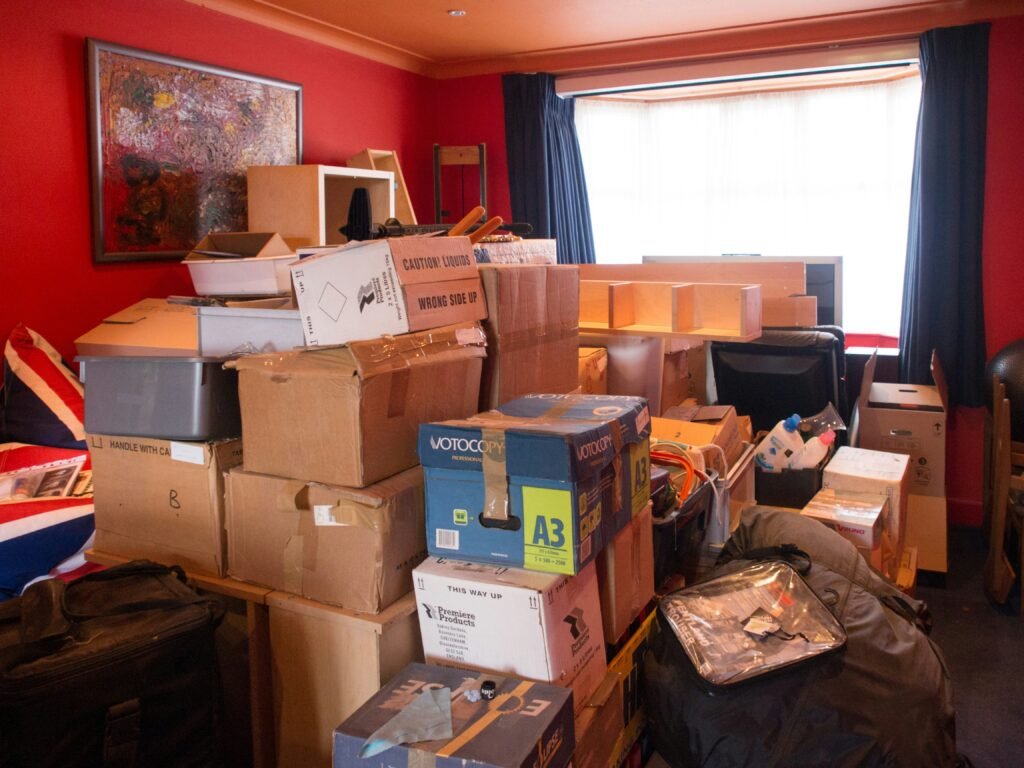
The decluttering part is the part everyone writes about. You empty the closet, you make your piles, you stand back and feel lighter. Good.
Then the piles sit there.
They move from the bedroom to the hallway, from the hallway to the garage, and by the following weekend the garage looks worse than the closet ever did. Nothing actually left the house. It just changed address.
That’s where most cleanouts quietly fall apart — not in the sorting, but in the getting rid of. So here’s the other half of the job: what to do with everything once you’ve decided it’s going.
Sort by where it’s going, not by what it is
Most sorting advice has you group things by category. Clothes here, books there, kitchen odds and ends in the third pile. That’s useful while you’re deciding. It’s not much use once you’ve decided.
The moment something is officially leaving, it belongs to one of four destinations: sell, donate, recycle, or throw out. Those aren’t labels — they’re routes, and each one leaves your house a different way, on a different day, with a different amount of effort attached.
Re-sorting by destination takes about twenty minutes and saves you a weekend, because every pile now has a next step instead of a description.
Be honest about what’s actually worth selling
The sell pile is where cleanouts go to die.
It’s the most optimistic pile in the house. Everything in it feels like it has value, because you paid for it once. But selling takes photographs, listings, messages from people who never show up, and a corner of your house held hostage until it’s done.
A decent test: would you spend an hour of a Saturday to get that item’s asking price? If not, it’s a donation, not a sale. Furniture in genuinely good condition, tools, bikes, and anything with a brand name behind it are usually worth listing. Mass-market particleboard furniture, old textbooks, and worn small appliances usually aren’t.
Then give the pile a deadline. Two weeks is plenty. Whatever hasn’t sold by then gets donated — no renegotiating with yourself.
Know what donation centers will turn away
People assume charities take anything. They don’t, and showing up with a car full of rejects is a genuinely demoralizing way to spend a morning.
Most donation centers won’t accept mattresses, cribs and car seats, opened paint, broken or heavily worn furniture, tube televisions, or anything with a rip, stain, or missing part. Some won’t take large furniture at all unless it’s in near-resale condition, simply because they don’t have the floor space.
Two things make this easier. Call ahead and ask what they’re accepting this week — it changes with their stock. And ask whether they do pickups, because many will collect larger items for free if you book far enough in advance.
The rule of thumb: if you wouldn’t give it to a friend without apologizing for it, it’s not a donation.
Recycling usually means its own trip
A few categories can’t go in your regular bin and quietly ruin the recycling when they do.
Electronics are the big one. Old computers, phones, printers, and anything with a battery need an e-waste drop-off, and many retailers run take-back programs that cost nothing. Scrap metal is the opposite problem — it’s worth something, and metal recyclers will often take appliances, pipe, and old fencing off your hands.
Cardboard is worth flattening properly. Loose, un-flattened boxes are the fastest way to make a small load look enormous.
Some things can’t go in a bin at all
This is the category that stalls a cleanout for months, because there’s no obvious answer and nobody wants to guess wrong.
Paint, solvents, motor oil, pesticides, pool chemicals, propane tanks, and old fuel are all household hazardous waste. They don’t go curbside, they don’t go in the dumpster, and they shouldn’t go down a drain. Most areas run a hazardous waste facility or a collection day a few times a year — that’s the answer, and it’s usually free for households.
Latex paint is the exception worth knowing. Once it’s fully dried out, it can generally go in the regular trash, so leaving the lid off a nearly-empty can for a week solves the problem by itself.
Be realistic about volume
Here’s the part almost everyone underestimates.
A single decluttered closet fits in a car. A decluttered house does not. The pile from a three-bedroom home is not a few trips — it’s a truckload, and it takes up a startling amount of room the moment it comes out of cupboards and off shelves. Storage compresses things. Floors don’t.
It’s worth knowing how municipal solid waste is handled where you live before you start, because that determines almost everything about your timeline. Transfer stations often charge by weight and keep short hours. Bulk collection may run monthly, or twice a year. A skip or dumpster might need a permit if it’s going on the street.
None of that is difficult. It’s just slow if you find out about it on the day.
When it’s worth bringing in a crew
You can absolutely do this yourself, and for one room you probably should.
It gets harder fast when the volume climbs. Stairs, narrow doorways, and heavy items are where DIY cleanouts turn into a second weekend and a sore back — mattresses, sofas, exercise equipment, appliances, and anything involving a basement or an attic. Add in the dump runs, the donation drop-offs, and the separate trip for the paint, and a “free” cleanout has quietly eaten several days.
Local companies handle this all the time, and the sorting is usually the part that’s worth paying for. In Boise, for example, Top Shelf Junk Removal works the way most reputable haulers do: the crew loads everything themselves, then splits the load so usable furniture and appliances go to charities and metals go to recyclers rather than straight to landfill. Pricing is typically by volume — the space your load takes in the truck — which is why an honest estimate needs someone to see the pile, or at least a few photos of it.
That trade-off changes with scale. For a single room, hiring someone is a convenience. If you’re clearing out an entire house after a move, an inheritance, or a renovation, it’s usually the difference between finishing and not.
Give the whole thing a deadline
Cleanouts expand to fill whatever time you give them, so don’t give them unlimited time.
Pick the date the last item leaves the property and work backwards from it. Book the collection, the pickup, or the crew first — before you’ve sorted a thing. A booked date does something a to-do list can’t: it turns “eventually” into Thursday, and it stops the piles from settling in.
If you’re moving or selling, work back from that date instead. Everything is easier while the house is still yours and the calendar isn’t in charge yet.
A quick disposal checklist
Before you start pulling things out of cupboards:
- Re-sort by destination — sell, donate, recycle, dispose — not by category
- Call your donation center and ask what they’re taking, and whether they collect
- Find your nearest e-waste and hazardous waste drop-off, and check the hours
- Check whether bulk pickup exists where you live, and when it next runs
- Confirm whether a dumpster needs a permit on your street
- Set a two-week deadline on the sell pile, and a hard end date for the whole job
- Book the truck, skip, or pickup before you sort anything
Final thoughts
Decluttering is a decision. Getting rid of things is logistics, and logistics is what actually determines whether your house looks different in a month.
The good news is that the logistics part is finite. There are only four destinations, each one has rules you can learn in a phone call, and the whole thing gets easier the moment there’s a date attached to it. Sort by where things are going, find out what your area accepts before you begin, and book the exit before you open the first cupboard.
Do that, and the piles leave. Which was the point.
Also Read: How to Unpack & Place Delicate Items After Moving