The Quick Rundown
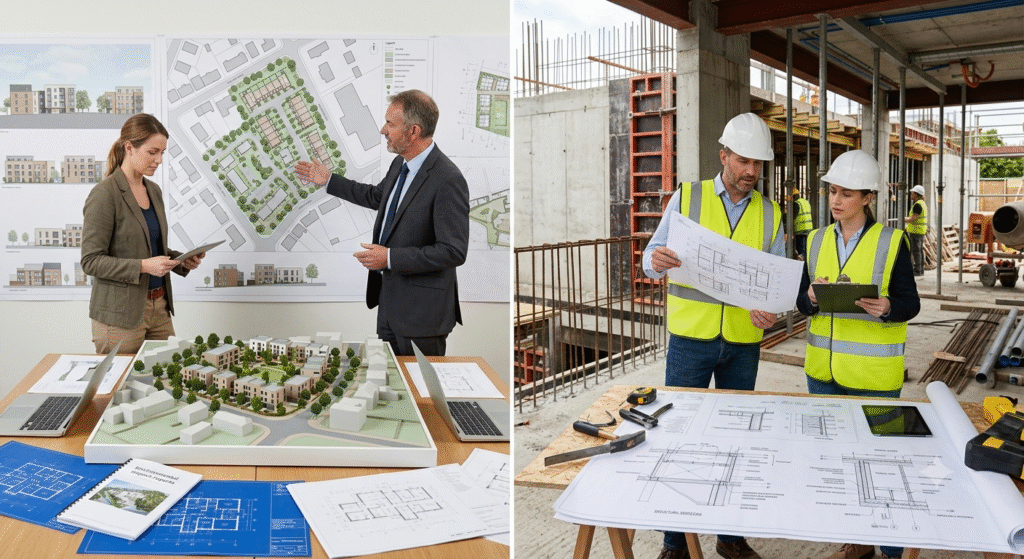
- Planning permission settles the what and the where. It judges whether a development suits its location, the zoning, and the wider community.
- A building permit governs the how. It confirms the construction itself will stand up safely and meet technical building codes.
- Separate departments handle the 2 approvals, under different legislation, even when both applications land at the same council.
- Planning approval almost always lands first. A building permit follows once the construction detail satisfies that approval and the building code.
- Both are not always needed. Plenty of minor jobs need only a building permit, and some sit under exemptions or permitted development with no planning approval at all.
- Wording is regional. “Planning permission” is mainly British, “planning permit” is Australian, and in the US the land-use side usually takes the form of a zoning or land-use permit.
- Build without the right approval and you risk stop-work orders, daily fines, demolition orders, liens, voided insurance, and a stalled sale later on.
Add an extension, build a new home, or develop a vacant plot, and 2 phrases turn up fast: building permit and planning permission. They sound like the same thing. They are not. Treating them as one ranks among the costlier mistakes a property owner can make, because holding one approval tells you nothing about whether you hold the other. Skip either and a project can stall, rack up fines, or finish as a completed structure that has to come back down.
This guide lays out the difference in plain terms. It also explains why the wording shifts depending on where you live, which approval your project actually needs, the order they come in, and what enforcement looks like if you press ahead without them.
Where the Confusion Comes From
Most of the confusion here traces back to geography more than construction. The same 2 approvals carry different names from one country to the next, and articles written for a single market tend to present their local labels as though the whole world uses them.
British law splits the approvals into planning permission and building regulations approval, the latter usually managed through building control. Australia runs the identical pairing as a planning permit and a building permit. Over in the US and Canada, the technical sign-off is the building permit, while the land-use question gets folded into zoning approval or a planning permit.
So a search for building permit vs planning permission usually pairs an American term with a British one. Spot the underlying split, though, and every local label falls into place: land use sits on one side, construction safety on the other. The rest of this guide treats the 2 ideas by their regional names and tells you which is which.
What Is Planning Permission (or a Planning Permit)?
Planning permission is approval for the use and development of land. The question it answers is a big-picture one: should a structure of this kind exist in this spot at all? A planning officer is not checking whether your beams can carry the load. The decision rests on whether your proposal fits the character of the area, its zoning rules, and the long-term plan for the neighbourhood.
Questions like “Can I put a block of townhouses on this residential street?” or “Can I convert this shop into flats?” are planning questions. The textbook case: you cannot drop an industrial factory into the middle of a residential zone. The construction might be flawless, yet the land use is simply wrong for the location.
What the planning process looks at
Assessing a planning application means weighing how a project affects everything around it. The usual considerations include:
- Land use and zoning: whether the proposed use is permitted in that zone.
- Density and scale: the height and footprint, plus how many dwellings are proposed.
- Appearance and design: external materials and colours, along with how the building sits among its surroundings.
- Impact on neighbours: privacy, overlooking, loss of light, noise, and traffic.
- Environmental and heritage factors: trees, waterways, flood risk, and any conservation or heritage overlay.
Because planning hinges on fit rather than engineering, the drawings you hand in describe layout and intent: where buildings sit, how access roads and parking work, the landscaping, heights, elevations, and the finishes you have in mind. Structural calculations do not come into it at this stage.
What Is a Building Permit (or Building Regulations Approval)?
A building permit deals with the how of construction. Once it is settled what can go on the site, the building authority makes sure the structure will be safe, sound, and code-compliant. This is the approval that lets you break ground legally.
The questions shift to the technical. Does the structure meet load and seismic standards, is the wiring safe, are the fire-protection measures up to scratch? Protecting the people who will use the building, along with anyone nearby, drives the whole review.
What the building process looks at
A building permit review digs into the technical detail. It typically covers:
- Structural integrity: the foundations and framing, plus every load-bearing element that holds the structure up.
- Fire safety: fire-resistance ratings and escape routes, backed by detection systems.
- Building services: electrical wiring and plumbing, alongside mechanical systems like heating and ventilation.
- Energy and access: current standards for energy efficiency and accessibility.
Getting a building permit means submitting detailed construction drawings that spell out the method of build, plus structural designs and calculations from an engineer proving the design meets the relevant code. These run far more technical than planning drawings. Sign-off usually comes from a building official, or in the UK and Australia from a building surveyor or approved inspector who might be private rather than part of the council.
The Core Differences at a Glance
The table below sums up how the 2 approvals differ. Read “planning permission” as “planning permit” or “zoning approval” for your region, and “building permit” as “building regulations approval” if you are in the UK.
| Planning Permission / Permit | Building Permit / Building Regs | |
| Core question | What and where can be built? | How will it be built safely? |
| Focus | Land use, zoning, community impact | Structural safety and code compliance |
| Concerned with | Appearance, density, privacy, traffic, environment | Structure, fire, electrical, plumbing, accessibility |
| Drawings needed | Layout, elevations, materials, site plan | Construction details, structural calculations |
| Typically assessed by | Local planning authority or council | Building department, surveyor, or inspector |
| Comes first? | Usually yes | After planning, where planning applies |
| Always required? | No, depends on project and location | Almost always for significant work |
Which Approval Comes First
Order matters when a project needs both. Planning permission generally has to be in hand before a building permit can be issued, and the logic is hard to argue with. No sense engineering the fine detail of a building you might not be allowed to put there.
Here is the catch. Planning permission does not guarantee a building permit will follow. Both get judged against entirely separate rulebooks, so a scheme can sail through planning and still trip up at building control if the construction detail misses code. Any building permit also has to stay consistent with the conditions and endorsed plans attached to the planning approval.
Can you run both at once? In theory, yes, and now and then it pays to do so to save time. In practice it stays rare, since most owners would rather not fund a fully detailed construction package before planning approval is secure. A sharp architect keeps both rulebooks in view from the first sketch anyway. A planning consent for something that could never pass building control helps nobody.
Do You Always Need Both?
No, and this is exactly where money gets wasted on approvals nobody needed, or lost on approvals somebody skipped. What you need comes down to the type and scale of the project, plus where it sits.
As a rough guide, plenty of small single-dwelling jobs such as modest extensions, garages, outbuildings, and internal alterations need only a building permit, no planning approval. Assume nothing, though. Location can override the lot. A property inside a heritage or conservation overlay, or one under special zoning controls, may need planning approval even for changes that would be trivial down the road. Commercial projects, and any site carrying multiple dwellings, almost always trigger planning.
In the UK, many ordinary home projects fall under permitted development, where planning permission is not required at all. Listed buildings and certain areas are carved out, and an Article 4 direction can strip those rights away. Even where planning is unnecessary, building regulations approval almost certainly applies to anything past minor repairs and decoration. Some US states and small projects escape building permits too, yet the safest move stays identical everywhere: check with your local building or planning department before a single tool comes out.
Who Issues Each Approval?
Separate departments handle the 2 applications, under different legislation, even when both arrive at the same council. That single fact explains why so many people assume one approval covers the other. The planning side goes to the local planning authority and gets judged against the zoning ordinance or planning scheme. The technical side sits with the building department.
The UK and Australia add a twist. Building approval need not run through the council at all. A private approved inspector or building surveyor can handle it independently, often with more flexibility, while still certifying full compliance. In the US, specialist work such as a septic system may route to the local health department rather than the building office.
How Long Each Takes and What It Costs
Timelines and fees swing widely by jurisdiction, project size, and how complete the application is, so treat what follows as broad guidance rather than fixed numbers.
For building permits, simple non-structural jobs can clear in a day or two, and a typical residential permit often issues inside 2 weeks. Bigger or more complex builds tell a different story. A new single-family home can run anywhere from a couple of weeks to 6 months, sometimes a full year, once plan checks, re-check cycles, and outside-agency reviews stack up. Roughly half of larger submissions need more than 2 plan-check rounds, so the biggest time-saver by far is filing complete, high-quality plans the first time.
On cost, building permit fees commonly land between $150 and $2,000 for residential work, and on larger projects they often get calculated as 0.5% to 2% of total construction value. Many areas sell expedited processing for an extra fee. Permit expediters, the professionals who wrangle the paperwork and the department relationships, usually charge $300 to $2,000 and can cut review time by a real margin.
Planning approvals pile their own timeline on top. Any project that sets off a public hearing or an environmental or heritage review can stretch out by months. Building that buffer into the schedule from day one saves real frustration later.
What Happens If You Skip Them?
Skipping the right approval looks tempting when permits feel slow and pricey. The downside runs deep and it lasts. Authorities turn up unpermitted work constantly: an inspector driving past, a neighbour filing a complaint, a property assessment, or a routine records check when you sell or refinance.
Penalties tend to climb through several stages:
- Stop-work orders: the moment unpermitted work surfaces, officials can halt the whole project until the violation is sorted.
- Fines: amounts vary sharply by location. California penalties can top $5,000 per violation, Massachusetts can reach $1,000 a day, and Texas can charge triple the permit fee plus a surcharge. Repeat offences escalate. Michigan, for one, treats a third violation as a felony carrying fines up to $25,000 or imprisonment.
- Retroactive permits: legalising work after the fact is sometimes possible, yet “as-built” permits run slower and a good deal pricier, often $2,000 to $8,000, and an inspector may insist that parts of the structure be opened up or redone.
- Demolition or removal orders: in serious cases, especially where safety is compromised, you can be ordered to tear the work down at your own expense.
- Liens and resale trouble: unpaid fines can attach as a lien on the property, insurers may decline to cover unpermitted work, and buyers or lenders often walk away from a home with undocumented construction.
Found unpermitted work, whether you did it or inherited it with the property? The smart play is to ring the building department, come clean, and ask about retroactive permitting. That route almost always costs less, and stresses you less, than getting caught.
How the Terms Map Across Countries
Since the labels cause the most trouble, here is how the 2 underlying approvals translate across the main English-speaking markets.
| Region | Land-use approval | Construction approval |
| United Kingdom | Planning permission | Building regulations approval (building control) |
| Australia | Planning permit | Building permit |
| United States | Zoning or land-use or planning permit | Building permit |
| Canada | Zoning or development permit | Building permit |
Names aside, the split holds everywhere. One approval decides whether the development belongs on that site. The other decides whether it gets built safely.
A Simple Way to Remember the Difference
Boil it down to this. Planning is about the place; building is about the structure. Planning permission asks whether your project should exist where you want it. The building permit asks whether what you are putting up is safe and built to code. Planning leads, building follows, and one never stands in for the other.
Frequently Asked Questions
Does planning permission mean I can start building?
No. Planning permission only confirms the development is acceptable in principle for that location. You still need a building permit, or building regulations approval, before construction can legally start, and it has to line up with your planning conditions.
Can I get a building permit without planning permission?
Sometimes. If your project does not require planning approval, say a minor extension under permitted development or an exemption, a building permit alone may do. Where planning is required, though, it generally comes first.
Do small projects need any approval?
It depends entirely on your jurisdiction. Some minor jobs are exempt. Plenty of seemingly small ones still need a building permit, including moving walls, altering rooflines, changing window openings, or any electrical and plumbing work. When in doubt, a quick call to the building department can save thousands in fines.
Who decides whether my construction is safe?
The building authority does, through the building permit process and the inspections that follow. Depending on where you are, that means a council building department, a municipal building official, or a private building surveyor or approved inspector.
The Bottom Line
The gap between a building permit and planning permission comes down to 2 distinct questions handled by 2 distinct authorities. Is this development right for this place? And is it being built safely and to code? Most sizeable projects need both answers, planning usually goes first, and one approval never replaces the other.
Before committing to any build, pin down exactly which approvals your project and location call for with the local planning and building departments. A short conversation up front costs almost nothing, and it heads off stop-work orders, fines, and the headache of unpermitted work turning up years down the line.