The Quick Rundown
- An accent wall is a single wall treated differently from the others to create a focal point in a room.
- The best candidate is usually a large, uninterrupted rectangle with minimal windows or doors.
- Paint is the most affordable option ($50-$100 total); wood paneling and stone cost significantly more.
- The wall you choose matters more than the material or color you put on it.
- Bedrooms, living rooms, entryways, and dining rooms are the most effective rooms for accent walls.
- Kitchens and bathrooms with heavy cabinetry are generally poor candidates.
- Color should echo something already in the room, not appear out of nowhere.
- Board and batten, shiplap, slat walls, and wallpaper murals are among the most popular treatments right now.
Bare walls are fine. But a well-placed accent wall does something no gallery print or statement lamp can quite replicate: it redefines the entire room without touching a single piece of furniture. One wall gets a different treatment, and the whole space reads differently.
The problem is that accent walls are easy to get wrong. Pick the wrong wall, use the wrong color, or choose a material that fights with your trim, and the result looks choppy rather than intentional. This guide covers everything you need to make a confident decision: which wall to choose, what to put on it, room-specific ideas, cost breakdowns, and the mistakes that most homeowners make.
What Makes a Good Accent Wall
Before you pick a color or material, pick the right wall. This is the step most guides skip, and it’s the one that matters most.
The human eye reads contrast before it reads color. When you walk into a room with an accent wall, your brain registers the shape of that contrasting area first. If that shape is clean and simple, your brain relaxes and appreciates the color or texture within it. If the shape is interrupted by asymmetric windows, doors at odd intervals, or angled ceiling lines, the wall reads as busy and disjointed, regardless of how beautiful the material is.
The ideal accent wall is a large, largely uninterrupted rectangle. Classic examples include the headboard wall in a bedroom and the TV wall in a living room. Both tend to have minimal interruptions and sit directly in the sightline when you enter the room.
Walls with windows can work, but only when the windows are symmetrically spaced. A row of three evenly placed windows is fine because the symmetry is easy on the eye. One narrow window at one end and a large window at the other creates random bright spots that fragment your color or pattern.
Walls beneath vaulted or cathedral ceilings are trickier. The angled ceiling line means your eye is trying to make sense of an irregular shape rather than settling comfortably on a rectangle. It can work, but it requires more care.
The first wall you see when you enter a room is usually the best choice. That’s the wall that sets the tone for the space and creates the first impression. In a bedroom, that’s typically the wall behind the bed. In a living room, it’s often the wall opposite the main entrance or the one anchoring the fireplace.
Accent Wall Ideas by Material
Paint
Paint is where most people start, and for good reason. It’s the cheapest, fastest, and most reversible option. A gallon of quality paint costs between $30 and $60, and the total project cost for a standard accent wall rarely exceeds $100 when you do it yourself.
But “just paint it a different color” undersells what paint can actually do. A few approaches worth considering:
Solid color: The most common approach. Choose a shade two to four steps darker or lighter than your existing walls, or go for a completely different hue that echoes something already in the room (a throw pillow, a rug, a piece of artwork). Benjamin Moore recommends choosing a color that appears in at least one other element in the room so the accent wall feels intentional rather than random.
Color blocking: Divide the wall into two tones, typically 50/50 or 75/25. The line where the colors meet becomes a design element in itself. This works particularly well in children’s rooms and teen bedrooms.
Two-tone walls: Paint the lower portion one color and the upper portion another, with the transition line sitting at chair rail height (roughly 32-36 inches from the floor). This is a more architectural approach that works well in dining rooms and hallways.
Painted patterns: Buffalo check, stripes, and geometric shapes can all be achieved with paint and painter’s tape. These take more time and precision, but the material cost stays low.
Textured paint techniques: Stippling, sponging, rag rolling, and limewash finishes add dimension without requiring any additional materials beyond the paint itself. Limewash in particular has surged in popularity for its matte, aged appearance that reads as sophisticated rather than trendy.
The best colors for accent walls right now include hunter green (pairs well with rattan, wood, and leather), deep navy (works in both contemporary and traditional rooms), warm terracotta (adds earthiness without being overwhelming), dusty plum (creates a moody, luxurious feel in bedrooms), and matte black (bold but surprisingly versatile in rooms with high ceilings and good natural light).
Wallpaper and Murals
Wallpaper has moved well past the floral patterns of the 1980s. Today’s options include grasscloth, geometric prints, botanical murals, abstract art-style panels, and peel-and-stick versions that require no paste and no professional installer.
The key advantage of wallpaper over paint is that it can function as art. A large-scale botanical mural behind a bed eliminates the need for a headboard and any wall art in that zone. A geometric grasscloth on the ceiling of a powder room turns an afterthought into a destination.
Wallpaper costs range from $0.50 to $5 per square foot for standard options, with designer and custom murals running considerably higher. Peel-and-stick versions sit at the lower end of that range and are a practical choice for renters or anyone who wants the option to change things up without repainting.
Designer Allison Garcy, whose work has appeared in Architectural Digest, puts it well: “Accent walls can easily overpower a bedroom, so the goal is balance. Layering mural-like wallpaper, texture, and jewel-toned upholstery allows the room to feel expressive without losing its sense of ease.”
Moisture-resistant wallpaper is now available for bathrooms, which opens up the option for bold pattern in a space that previously relied on tile alone.
Wood Paneling
Wood is the most popular material for accent walls right now, and the range of styles is wide enough to suit nearly any interior.
Shiplap: Horizontally stacked boards with a small gap between each one. The gap creates a shadow line that adds depth. Shiplap is associated with farmhouse and coastal aesthetics but reads as clean and contemporary when painted white or a solid color. Installing it vertically rather than horizontally makes rooms feel taller. Diagonal installation creates a herringbone effect with more visual energy. Cost: $2.50 to $7.00 per square foot for materials, not including installation.
Board and batten: Vertical boards (the battens) are placed at regular intervals across the wall, with the wall surface itself visible between them. The result is a textured, architectural look that works in farmhouse, transitional, and even contemporary spaces depending on the spacing and finish. Board and batten is particularly effective in entryways and hallways, where it adds height and formality. A weekend DIY project for someone with basic carpentry skills.
Slat walls: Horizontal, vertical, or diagonal slats with visible gaps between them. The contemporary version of shiplap, slat walls have a cleaner, more modern profile. They also offer practical benefits: the gaps can accommodate shelves, hooks, or lighting strips. Popular in home offices, entryways, and behind beds.
Reclaimed wood: Each plank carries its own history, with weathered textures, knots, and color variation that no new lumber can replicate. Reclaimed wood is an eco-conscious choice that adds warmth and authenticity. It works particularly well in living rooms and dining rooms where the organic texture contrasts with modern furniture.
Wainscoting: Wooden panels or moulding installed along the lower portion of the wall, typically to chair rail height. A traditional treatment that adds refinement to dining rooms, hallways, and formal living spaces. Raised panels, beadboard, and shaker-style wainscoting are the three main variations.
Picture frame moulding: Rectangular or square frames created from moulding strips, arranged in a grid pattern across the wall. The frames can be left empty (letting the wall color show through) or filled with wallpaper, paint, or fabric. A versatile treatment that works in both traditional and transitional interiors.
Tambour and slat paneling: Thin, flexible wood strips mounted on a backing material. The result is a ribbed, textured surface that catches light differently throughout the day. Tambour paneling has appeared in high-end hotel lobbies and residential projects alike, and it’s increasingly available as a DIY product.
Stone and Brick
Stone and brick bring a tactile quality that no painted surface can match. The weight and permanence of stone changes the feeling of a room in a way that’s hard to quantify but immediately felt.
Exposed brick: Authentic exposed brick is a feature of older buildings, but faux brick panels and brick veneer tiles replicate the look in new construction or renovated spaces. The industrial, urban aesthetic pairs well with leather furniture, metal fixtures, and warm wood tones.
Stacked stone: Stone veneer panels installed in a stacked pattern. The result is a dramatic, textural wall that works in living rooms, entryways, and outdoor-indoor transition spaces. Stone is particularly effective around fireplaces, where it extends the natural material of the surround across the entire wall.
Natural stone veneer: Thin slices of real stone mounted on a backing panel. Lighter than full stone, easier to install, and available in marble, slate, quartzite, and dozens of other materials. Cost: $6 to $20 per square foot for materials.
Stone is generally not recommended for kitchens or primary bathrooms because the irregular surface is difficult to clean around cabinetry and fixtures.
Tile
Tile is the practical choice for wet areas, but it’s also a genuine design statement in its own right. Bold patterned tile on a bathroom wall delivers the visual impact of wallpaper with the durability of a waterproof surface.
Emilie Munroe of Studio Munroe in San Francisco recommends tile for clients who want pattern in damp areas: “We utilize bold patterned tile to emulate the visual impact of wallpaper with the added durability of tile.” Extending the same tile from the floor up a single wall creates a cohesive, intentional look rather than a patchwork of different materials.
Mosaic tile is particularly effective in small bathrooms, where the intricate pattern adds visual interest without making the space feel smaller. Subway tile in an unexpected color or laid in a herringbone pattern transforms a standard bathroom into something more considered.
Mirrors and Reflective Surfaces
A mirrored accent wall is equal parts decorative and functional. In small spaces like powder rooms, a mirrored wall reflects light and creates the illusion of depth. Layering a smaller framed mirror over a larger mirrored surface, as designer Meg Lonergan has done across multiple projects, adds a collected, curated quality.
Antique mirror glass, with its slightly cloudy, aged appearance, is a more sophisticated alternative to standard mirror. Large-format antique mirror panels on a single wall create a sense of depth without the stark reflectivity of modern mirror.
Three-Dimensional Panels
3D wall panels made from MDF, PVC, or natural fiber add texture and depth without color. The panels catch light differently throughout the day, creating subtle shadows that shift as the light source moves. They’re particularly effective in home offices, where the acoustic benefits (many panels absorb sound) are a practical bonus alongside the visual interest.
Geometric 3D panels in neutral tones work well in contemporary and minimalist interiors where a bold color would feel out of place.
Accent Wall Ideas by Room
Living Room Accent Wall Ideas
The living room is the most common space for an accent wall, and the options are broader here than anywhere else in the home.
The TV wall is a natural candidate. A dark, matte paint color behind the television reduces glare and frames the screen as an intentional design element rather than a piece of technology dominating the room. Stone or wood paneling around a fireplace extends the material of the surround across the entire wall, creating a sense of permanence and craftsmanship.
For a more dramatic approach, a large-scale wallpaper mural on the wall behind a sofa turns the seating area into a destination. Botanical, landscape, and abstract art-style murals work particularly well in living rooms because the scale of the wall can accommodate the full pattern without cropping.
A gallery wall is another living room option, but it works best when treated as a curated collection rather than a random arrangement of frames. Mix sizes, vary hanging heights, and include objects alongside framed art (a clock, a sculptural piece, a basket) to give the wall a collected, personal quality.
Bedroom Accent Wall Ideas
The headboard wall is the default choice in a bedroom, and it’s the default for good reason. It’s the wall you face when you walk in, it’s the wall you see when you’re lying in bed, and it’s usually the largest uninterrupted rectangle in the room.
A dark, saturated color behind the bed creates a cocoon effect that makes the sleeping area feel more intimate. Designer Kevin Francis O’Gara describes the approach: “I carried the dark brown paint color onto the ceiling trim to accentuate the molding and create a cocoon effect around the bed. By emphasizing this architectural detail, I created a focal point, anchoring the side of the room where the bed is positioned.”
Wood paneling on the headboard wall, particularly slat or shiplap, adds warmth and texture without the commitment of a bold color. Extending the paneling from the wall onto the ceiling creates an immersive, enveloping quality.
Wallpaper murals in bedrooms should be chosen for their calming rather than stimulating qualities. Botanical prints, soft watercolor landscapes, and tonal geometric patterns all work well. Avoid high-contrast, busy patterns in spaces where you’re trying to wind down.
For children’s rooms, the accent wall is an opportunity for genuine playfulness. Bold colors, graphic patterns, and even hand-painted murals are all appropriate here, and the lower stakes (children’s tastes change quickly) make it a good space to take risks.
Entryway and Hallway Accent Wall Ideas
The entryway is the first thing guests see, and an accent wall here sets the tone for the entire home. Because entryways are often narrow and transitional, the accent wall treatment tends to be more architectural than decorative.
Board and batten is a classic entryway treatment. The vertical lines draw the eye upward, emphasizing ceiling height, and the paneling adds a sense of formality and welcome. Painting the board and batten a deep color (forest green, navy, charcoal) makes the entryway feel intentional and considered.
Wallpaper in an entryway can be bolder than anywhere else in the home because the exposure is brief. A pattern that would feel overwhelming in a living room reads as a confident design statement in a hallway.
A gallery wall along a long hallway transforms a transitional space into a destination. Designer Nicole Arruda describes the approach: “This long hallway was the perfect opportunity to bring in some interest. It leads to the main living areas, so we wanted to make a statement.”
Dining Room Accent Wall Ideas
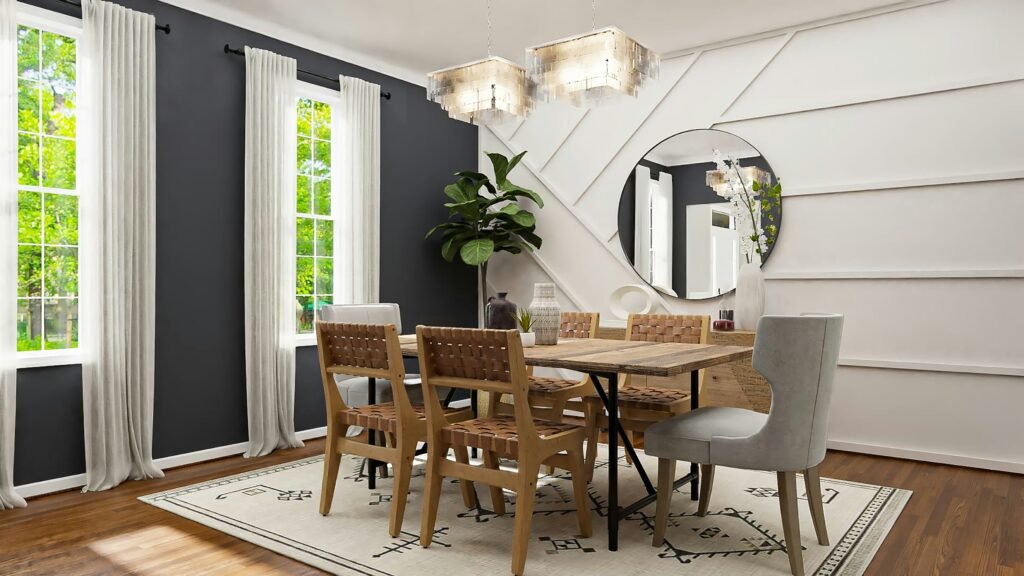
The dining room is one of the best rooms for a bold accent wall because the exposure time is longer than an entryway but the space is still contained. Guests spend time in the dining room, which means the wall gets noticed and appreciated rather than just glimpsed.
Deep, saturated colors work particularly well in dining rooms. Red is a traditional choice because it’s known to stimulate appetite and conversation. Navy, forest green, and deep plum are more contemporary alternatives that create the same sense of enclosure and warmth.
A textured material like grasscloth wallpaper or limewash paint adds depth to a dining room wall without the visual busyness of a pattern. The texture catches candlelight and changes character depending on the time of day.
Bathroom Accent Wall Ideas
Bathrooms present a specific set of constraints: moisture, limited wall space, and the presence of fixtures that interrupt any wall treatment. The best approach is to identify the single wall with the fewest interruptions and treat that one.
The wall behind a freestanding tub is the classic bathroom accent wall. A stone or tile treatment here frames the tub as a focal point and creates a spa-like quality. Mosaic tile, bold patterned tile, and natural stone veneer all work well in this position.
In smaller bathrooms, the wall behind the vanity is often the only viable option. A moisture-resistant wallpaper with a bold pattern, a limewash finish in a deep color, or a simple painted accent in a contrasting tone can all transform a utilitarian space into something more considered.
Avoid accent walls in bathrooms with heavy cabinetry or multiple fixtures on the same wall. The interruptions create a fragmented, choppy appearance that undermines the effect.
Home Office Accent Wall Ideas
The home office is an underutilized space for accent walls, but it’s one of the most rewarding. You spend a significant portion of the day in this room, which means the wall behind your desk or monitor is constantly in your sightline.
A hand-painted mural or large-scale wallpaper behind the desk creates a backdrop that makes video calls more visually interesting and the work environment more inspiring. Designer Lisa Gilmore, who commissioned a hand-painted mural for a client’s home office in St. Petersburg, Florida, describes the result: “The home office is now full of positive energy and the happiness of waterfront living.”
3D panels are a practical choice for home offices because they absorb sound as well as adding visual interest. A slat wall behind the desk also provides a surface for mounting shelves, hooks, and cable management solutions.
How to Choose the Right Color
Color selection is where most accent wall projects go wrong. The most common mistake is choosing a color in isolation, without reference to what’s already in the room.
The rule that works consistently: choose a color that already exists somewhere in the room. Pull a tone from a rug, a throw pillow, a piece of artwork, or even the grain of a wood floor. When the accent wall color echoes something already present, the wall feels like part of the room rather than an addition to it.
For contrast, go two to four shades darker or lighter than your existing wall color rather than jumping to a completely different hue. This creates a clear distinction without the jarring effect of two unrelated colors sharing a room.
If your existing walls are a mid-tone, a lighter accent wall can open up the space. If your walls are already light, a darker accent creates depth and definition.
Warm tones (terracotta, amber, rust, warm brown) create an inviting, cozy atmosphere that works well in living rooms, dining rooms, and bedrooms. Cool tones (navy, slate blue, sage green, soft gray) promote calm and work well in bedrooms and bathrooms. Neutral tones (charcoal, warm white, greige) are the safest choice for open-plan spaces where the accent wall needs to coexist with multiple zones.
Design Rules Worth Knowing
One accent wall per room. Two accent walls in the same space compete with each other and dilute the impact of both. The exception is the ceiling, which can be treated as a fifth wall without conflicting with a vertical accent wall.
The accent wall should be the wall the eye naturally goes to first. Don’t force an accent wall onto a wall that isn’t a natural focal point. If the room has an existing focal point (a fireplace, a large window, a built-in bookcase), the accent wall should work with that feature, not against it.
Scale matters. An accent area that’s too small looks like a mistake. The contrasting zone needs to carry enough visual weight to read as intentional. A niche painted a different color rarely works unless the niche is large enough to function as a room within a room.
Cohesion over contrast. The accent wall should feel like it belongs in the room, not like it was imported from a different design scheme. The color, texture, and material should all relate to what’s already present.
Avoid kitchens and primary bathrooms. Both rooms have too many interruptions (cabinets, appliances, mirrors, shower enclosures) to support a clean accent wall. The result tends to look like a series of dark strips surrounding the fixtures rather than a coherent feature.
Accent Wall Costs at a Glance
| Material | DIY Cost (Materials Only) | Professional Installation |
| Paint | $50-$100 | $150-$400 |
| Wallpaper | $80-$300 | $300-$800 |
| Peel-and-stick wallpaper | $60-$200 | N/A (DIY-friendly) |
| Shiplap | $200-$600 | $600-$1,500 |
| Board and batten | $150-$400 | $500-$1,200 |
| Slat wall panels | $200-$500 | $500-$1,200 |
| Stone veneer | $300-$800 | $800-$2,500 |
| Tile (bathroom) | $200-$600 | $600-$1,800 |
| 3D panels | $150-$400 | $400-$900 |
Labor costs typically run $25 to $100 per hour depending on the complexity of the project and your location. For most wood paneling projects, expect to add $7 to $15 per square foot for professional installation on top of material costs.
Budget an additional 10 to 15 percent of your total estimate for unexpected costs: extra material for waste, primer, patching compound for existing wall imperfections, or trim work.
Common Mistakes to Avoid
Choosing the wrong wall. The most impactful accent wall is usually the one you see first when you enter the room. Putting the accent on a side wall or a wall that’s partially hidden by furniture wastes the effect.
Ignoring the shape of the wall. Asymmetric windows, doors at odd intervals, and angled ceiling lines all undermine the clean rectangle that makes an accent wall work. If the wall isn’t a clean shape, the treatment will look choppy.
Picking a color with no connection to the room. An accent wall that introduces a completely new color with no echo elsewhere in the room looks like an afterthought. The color needs to be grounded in the existing palette.
Going too small. An accent area that’s too small reads as a mistake rather than a design choice. The contrasting zone needs enough visual weight to make sense in the space.
Doing two accent walls in the same room. Two competing accent walls cancel each other out. Pick one.
Treating the kitchen or primary bathroom as an accent wall candidate. The interruptions from cabinetry, appliances, and fixtures create a fragmented result. These rooms are better served by a cohesive, single-color approach.
Painting a niche a contrasting color. Unless the niche is very large (large enough to hold a bed, for example), painting it a dark color creates a choppy, dated look. Let the objects inside the niche do the work.
Frequently Asked Questions
Are accent walls still in style?
Yes, with a caveat. The dated version of the accent wall (a single wall painted a random bold color with no connection to the rest of the room) has fallen out of favor. The current approach is more considered: the material, color, and placement are all intentional, and the accent wall feels like a natural extension of the room’s design rather than a trend-driven addition.
Which wall should be the accent wall in a bedroom?
The headboard wall is the standard choice. It’s the wall you face when you enter the room, the wall you see from the bed, and it’s usually the largest uninterrupted rectangle in the space. The wall behind the bed also frames the bed as a focal point, which is the intended effect.
Can you do an accent wall in an open-plan space?
Open-plan spaces are more challenging because the accent wall needs to coexist with multiple zones. The safest approach is to choose a wall that defines one specific zone (the dining area, the living area, or the kitchen) and use a color or material that relates to the furniture and decor in that zone specifically.
How long does an accent wall take to install?
A painted accent wall can be completed in a day. Wallpaper typically takes four to eight hours for a standard wall. Wood paneling (shiplap, board and batten, slat walls) usually requires a full weekend for a DIY project. Stone veneer and tile installations take longer and are generally better suited to professional installation.
Should the accent wall be lighter or darker than the other walls?
Either can work. A darker accent wall creates depth and definition, making the space feel more intimate. A lighter accent wall in a room with darker existing walls can open up the space and add brightness. The key is that the contrast is intentional and the color connects to something already in the room.
Can you do an accent wall in a small room?
Yes, and it can actually make a small room feel larger when done correctly. A dark accent wall on the far wall of a narrow room creates the illusion of depth. Mirrored accent walls reflect light and expand the perceived space. Avoid busy patterns in very small rooms, as they can make the space feel cluttered.
The Bottom Line
An accent wall works when the wall choice is deliberate, the color or material connects to the room’s existing palette, and the treatment is executed cleanly. The material matters less than the decision about which wall to use and why.
Start with the wall. Ask whether it’s a clean rectangle, whether it’s the natural focal point of the room, and whether it has enough uninterrupted surface area to carry the treatment. If the answer to all three is yes, the rest of the decisions (paint vs. wallpaper, dark vs. light, pattern vs. texture) become much easier.
The best accent walls don’t announce themselves as accent walls. They just make the room feel more complete.