Key Takeaways
- Adobe walls need to breathe—use vapor-permeable, non-film-forming coatings or paints verified as breathable.
- Top choices are limewash, mineral paint (potassium silicate), and 100% acrylic paint formulated for masonry.
- Waterproof sealers, PVC/PVA primers, and standard acrylic paints trap moisture in adobe and speed up decay.
- Surface prep—crack repair, thorough cleaning, and the right sealer—often decides whether a finish lasts 2 years or 20.
- Do not spray adobe without back-rolling; spraying alone skips the textures and crevices that turn into leak points.
- Many adobe specialists suggest leaving exterior walls unpainted to preserve breathability, character, and resale value.
- Historic districts in the Southwest enforce color restrictions; check local rules before picking any exterior color.
What Makes Adobe Houses Different to Paint
The Nature of Adobe Walls
Adobe is among the oldest building materials on earth. Bricks made from soil—typically a blend of sand, silt, and clay—mixed with water and sun-dried have supported homes in the American Southwest, Mexico, parts of the Middle East, and across sub-Saharan Africa for centuries. In its natural state, adobe carries warm hues from pale beige to deep reddish brown, shifting subtly with light and time of day.
That beauty comes with a trait every painter must grasp before opening a can: adobe is porous. The wall behaves like a sponge, constantly soaking up and releasing moisture from rain, ground wicking, and indoor humidity. This is by design, not a defect. Adobe regulates both temperature and moisture through that exchange. Interfere with that process and problems follow.
Why Breathability Is the Number One Rule
Vapor permeability should sit at the top of your criteria for paint selection. If a coating seals the surface and blocks moisture vapor from escaping, the moisture will push elsewhere. It migrates into the wall, builds up behind the paint film, then blisters, peels, spalls, and feeds mold. In severe cases, the adobe matrix itself begins to weaken.
Adobe master Roy Spears, with more than 40 years of adobe experience, explains it simply: “Adobes are like sponges, and water is going to get to them.” Water itself is not the enemy—adobe has managed it for millennia. The issue is a coating that blocks the wall’s own moisture management. A breathable paint cooperates with the wall; a waterproof film fights it.
Should You Paint Your Adobe House at All?
The Case for Leaving Adobe Unpainted
Before comparing products, ask whether painting is the right move in the first place. Roy Spears, widely cited in adobe construction and maintenance, does not advocate routine exterior painting. His reasons are practical and aesthetic. Paint masks the distinctive earthen look and, in his words, “throws it into the same league as any one of a number of other typical painted masonry homes.” In regions where natural adobe is prized—especially in New Mexico, Arizona, and Colorado—that change can reduce resale value.
Properly maintained, unpainted adobe finished with mud plaster or earthen render manages moisture on its own, avoids film-forming coatings, and keeps the warm, tactile appearance that defines adobe architecture. When walls are sound and the earthen plaster is performing well, the most historically appropriate—and often the most durable—choice is to leave them as they are.
When Painting Adobe Makes Sense
There are situations where paint is appropriate and helpful. Asphalt-stabilized adobe that is eroding quickly under severe weather can benefit from a breathable coating that slows surface wear. Burnt adobe—fired at high temperatures—can also weather faster in harsh climates, and a protective, vapor-open finish may extend service life. If the structure is in excellent condition with no drainage issues and no below-grade moisture, a carefully selected exterior paint can be a reasonable path.
If the real problem is irrigation overspray, poor site drainage, or moisture wicking from below grade, do not paint. Any coating—breathable or not—will compound the issue by trapping moisture in the wall. Fix the water source first. Paint is a finish treatment, not a structural fix.
Best Types of Paint for Adobe Houses
Limewash: The Time-Tested Traditional Choice
Limewash has coated earthen and masonry walls for centuries, and it remains an excellent fit for adobe. Made from slaked lime and water, it penetrates the surface instead of forming a film. Because it does not create a sealed membrane, vapor passes through freely. On the ASTM E-96 scale, limewash typically measures 75 to 85 perms—among the most vapor-open wall finishes available.
Limewash brings other practical upsides. Its high pH discourages mold, bacteria, and insects. It contains zero VOCs, which makes it a strong option for interior spaces where air quality matters. The finish is soft, matte, and slightly translucent, reading as natural rather than painted—useful for anyone aiming to keep the adobe character while adding color.
Notable producers include Bauwerk Colour and Romabio Classico Limewash. Romabio’s Classico line has appeared on high-profile buildings such as the White House and the Palace of Versailles, and the company ages its lime for at least 12 months to improve adhesion and workability. On raw, absorbent earthen walls, expect roughly 7 to 10 square meters per liter per coat, with two to three coats for even coverage. Limewash dries much lighter than it looks wet, so test a small area and let it fully dry before proceeding.
The trade-off outdoors is service life. In high-UV, high-weather regions like the American Southwest, exterior limewash often needs refreshing every two to five years. That is normal for a mineral coating that wears gradually instead of peeling in sheets.
Mineral Paint: The Modern High-Performance Option
Potassium silicate mineral paint is the most advanced vapor-open option for adobe. Unlike acrylic films that sit on the surface, mineral paint bonds chemically to silica in masonry and earthen substrates through silicification. The coating becomes part of the wall rather than a skin on top, which means it does not peel, blister, or delaminate.
Alkemis Interior Mineral Paint is a leading product in this class, formulated specifically for adobe, rammed earth, and similar substrates. It carries a zero VOC rating (less than 1 gram per liter per ASTM D6886), holds Cradle to Cradle Certification, and has shown more than 20 years of satisfactory performance on mineral surfaces. Mineral pigments, rather than organic ones, deliver excellent UV stability—important in high-altitude Southwest areas where UV levels can run 70% higher than coastal cities. One gallon covers about 300 square feet, and most applications do not require a separate primer.
The main drawback is price. Mineral paint usually costs more than acrylic alternatives. For interiors and heritage properties where longevity and authenticity matter, the investment is easy to justify. For a budget-driven exterior repaint on a well-maintained home, verified-breathable 100% acrylic can be a sensible alternative.
100% Acrylic Paint: The Practical Everyday Choice
For a widely available option that can perform well on adobe, 100% acrylic paint is workable—if you select the right product and apply it correctly. Roy Spears recommends at least two coats of 100% acrylic on adobe in excellent condition and notes that proper application determines how long the finish endures. That “proper” qualifier is the difference between success and failure.
First, confirm vapor permeability. Acrylics vary in how vapor-open they are. Contact the manufacturer for a permeability rating before buying. Some general masonry acrylics will meet the requirement, but do not assume. Apply a breathable acrylic sealer such as Ram Seal Cure and Prime before painting to prepare the surface without sealing it off.
Second, use the right method. Spray-only application fails on adobe. The texture, nooks, and crevices demand back-rolling after each spray pass. A two-person team is most efficient: one sprays, the other immediately rolls to press paint into every irregularity. Areas the spray does not reach become water entry points that shorten the life of the coating.
Oil-Based Paint: A Durable Exterior Option
Oil-based paint sometimes appears on adobe exteriors when a thicker, more dirt-resistant finish is desired. Applied with a long-fiber roller or natural bristle brush, it covers textured masonry well. That said, oil-based paints are generally less vapor-permeable than limewash or mineral paint and require a compatible, breathable primer to avoid trapping moisture. For most adobe projects, oil-based systems rank behind limewash and mineral paint and demand close monitoring of moisture conditions before and after application.
Paints and Sealers to Avoid on Adobe
Waterproof Sealers and Film-Forming Coatings
Any product marketed as waterproof, moisture-proof, or water-impermeable should be kept entirely away from adobe walls. These coatings form a sealed membrane over the surface that prevents moisture vapor from escaping. Since adobe walls constantly manage moisture from multiple sources—rain, ground wicking, and interior humidity—that trapped moisture has nowhere to go. It accumulates behind the coating, expands and contracts with temperature changes, and eventually forces the coating off the wall in sheets. The adobe beneath is left in worse condition than if it had never been painted at all. Thompson’s Water Seal, for example, has received poor performance ratings from Consumer Reports and is not appropriate for adobe applications.
PVC and PVA Primers
PVC (polyvinyl chloride) and PVA (polyvinyl acetate) primers turn up regularly in hardware aisles as general masonry primers. On adobe, they lead to blistering. As with waterproof sealers, these films restrict vapor movement, pressure builds beneath them, and the finish ruptures. Use only primers specifically rated as vapor-permeable and avoid products listing PVC or PVA as the primary binder.
Standard Interior Paints Used Outdoors
Interior paints are built for stable conditions: steady temperatures, no UV, no rain. They often rely on organic pigments that fade quickly in sunlight and lack the UV stabilizers, extra binders, and crack resistance needed outside. On adobe exteriors, interior paint will chalk, fade, and crack—sometimes within a single season in high-UV climates. Choose an exterior masonry formulation for any exposed adobe surface.
Sealers and Primers for Adobe Walls
Interior Adobe Sealers
For dusty interior adobe, a simple consolidant helps. Mix one part white glue with three to four parts water and brush it over the wall, working into the mortar joints and brick faces. This reduces shedding while remaining vapor-open. A natural alternative is tapioca powder mixed with water, which performs similarly without synthetic ingredients. Both approaches slightly darken the wall and can soften the contrast between brick and mortar—a bonus if you plan to paint and want a more uniform base.
Exterior Adobe Sealers
Outside, a traditional sealer combines one part boiled linseed oil with three parts paint thinner. Apply it with cotton rags to the entire surface and allow at least 24 hours to cure. The wall darkens noticeably at first, then typically returns close to normal within about a month. Multiple coats of boiled linseed oil applied neat (without thinner) can produce a deeper, wet-look finish that some homeowners use as a final appearance.
Breathable Commercial Sealers
Several commercial options are designed to protect adobe while allowing vapor movement. OKON W-1 and W-2, recommended by adobe expert Quentin Wilson, reduce liquid water uptake while letting vapor escape. El Rey Stucco Adobe Sealer is formulated to breathe yet protect the surface. Ram Seal Cure and Prime is a breathable acrylic sealer well suited as a preparatory coat before an acrylic topcoat. These are safer bets than generic masonry sealers that do not publish vapor permeability.
Interior vs. Exterior Paint for Adobe Houses
Painting Interior Adobe Walls
Interiors allow more flexibility because there is no rain, intense UV, or freeze-thaw stress. Limewash, clay paint, and mineral paint all perform well inside and deliver beautiful finishes with zero or very low VOCs—important for living spaces. Breathability still matters; interior adobe buffers humidity from cooking, bathing, and everyday life, and a non-breathable coating will trap it. Favor low-VOC formulas for bedrooms and low-ventilation rooms.
Painting Exterior Adobe Walls
Exterior adobe faces rain, solar exposure, temperature swings, and freeze-thaw cycles. Those forces stress both the finish and the wall. Breathability becomes even more important outside because moisture loads are higher and fluctuate more. Silicate mineral paint offers the strongest long-term track record on exterior adobe, with mineral pigments that stand up to intense sun in high-altitude parts of the Southwest. Limewash is a traditional choice that may need refreshing every two to five years. Properly applied 100% acrylic can also serve on sound, well-drained walls. Large roof overhangs that shield walls from direct wetting extend any coating’s life.
How to Prepare an Adobe Wall for Painting
Inspecting and Repairing the Surface
Preparation is the single factor most likely to decide whether a finish holds up on adobe. Start with a careful survey of every surface. Press firmly at intervals to find soft spots where adobe has weakened beneath the skin. Note cracks, eroded mortar joints, and any paint that is peeling or lifting. Remove loose or deteriorated material and rebuild with a compatible filler before you paint.
Fill cracks with a mud or adobe-compatible filler. On unstabilized adobe, skip Portland cement-based products—cement’s rigidity creates stress at the repair edges as the wall moves seasonally, which leads to new cracks. Use a flexible earthen filler that moves with the wall and let all repairs cure completely.
Cleaning and Pressure Washing
- Brush the entire surface with a stiff bristle brush to remove dust, loose material, and flaking paint.
- Pressure wash exterior walls to clear dirt and biological growth, and to dislodge remaining loose debris.
- Let the wall dry thoroughly—typically 48 hours or more depending on weather. Painting damp adobe invites adhesion failure.
- Apply a suitable breathable sealer or primer (for example, diluted white glue indoors, boiled linseed oil outdoors, or a commercial breathable sealer).
- Allow the sealer to dry a minimum of 24 hours before painting.
Removing Old Non-Breathable Paint
If a previous non-breathable coating is failing, removal comes first. A new breathable coat over a sealed layer will not restore vapor flow; the moisture remains trapped. Removal is laborious. Start by misting the wall; sometimes the paint softens enough to scrape. Use a stiff wire brush or a long-handled scraper with replaceable blades to break the film and lift loose sections. For stubborn films, a rented wallpaper steamer can soften the paint so it scrapes cleanly. Do not sandblast adobe—the abrasion damages the bricks.
Step-by-Step Guide to Painting an Adobe House
Applying Limewash to Adobe
- Mix hydrated lime putty with clean water to a whole-milk consistency; add mineral pigments if you want color.
- Dampen the wall with clean water using a large brush or garden sprayer to slow absorption.
- Apply limewash with a large natural-bristle brush, working it into the pores with loose, crisscross strokes.
- Keep a wet edge across your working area to avoid lap marks; avoid stopping mid-wall.
- Let the first coat dry 1 to 2 hours, or until the sheen disappears.
- Apply a second, slightly richer coat; add a third if more opacity is needed.
Applying Acrylic Paint to Adobe
- Confirm the wall is fully dry and primed with a breathable acrylic primer.
- Work as a two-person team—one on the airless sprayer, the other immediately back-rolling.
- Spray a manageable section, aiming for even coverage without heavy build.
- Back-roll right away, pressing paint into crevices, nooks, and surface texture.
- Allow the first coat to dry fully as directed by the manufacturer.
- Apply a second coat using the same spray-and-back-roll approach.
Applying Mineral Paint to Adobe
- Make sure the surface is clean, dry, and free of organic residues or old films.
- If using a two-part pure silicate system, mix the dry powder and liquid potassium silicate binder precisely to the manufacturer’s specifications.
- Use a brush or roller and work the paint deeply into the texture so it bonds uniformly to the mineral substrate.
- Maintain a wet edge to prevent overlap marks.
- Let the first coat cure fully before recoating; follow the longer recoat window typical of mineral paints.
Best Paint Colors for Adobe Houses
Traditional Southwest Earth Tones
Authentic adobe color mirrors local mud plasters—tierra blanca, tierra amarilla, or tierra rosa tones developed from regional iron oxides and clays. Expect a narrow range of warm, low-chroma hues. Historically appropriate shades tend to fall between LRV 35 and 65 and lean warm with pink, peach, or yellow undertones. Pure whites, cool grays, and highly saturated hues read as modern and out of place.
Reliable, historically grounded options include Sherwin-Williams Pueblo Tan (SW 7572 Belvedere Cream), Benjamin Moore Adobe White (HC-37 Monroe Bisque), and Behr Warm Cream (PPU7-13 Mineral Yellow). For deeper tones, consider Benjamin Moore Adobe Dust (2175-40) or Sherwin-Williams Cavern Clay (SW 7701). These capture the warmth of earthen construction without drifting into artificial territory.
Accent and Door Colors
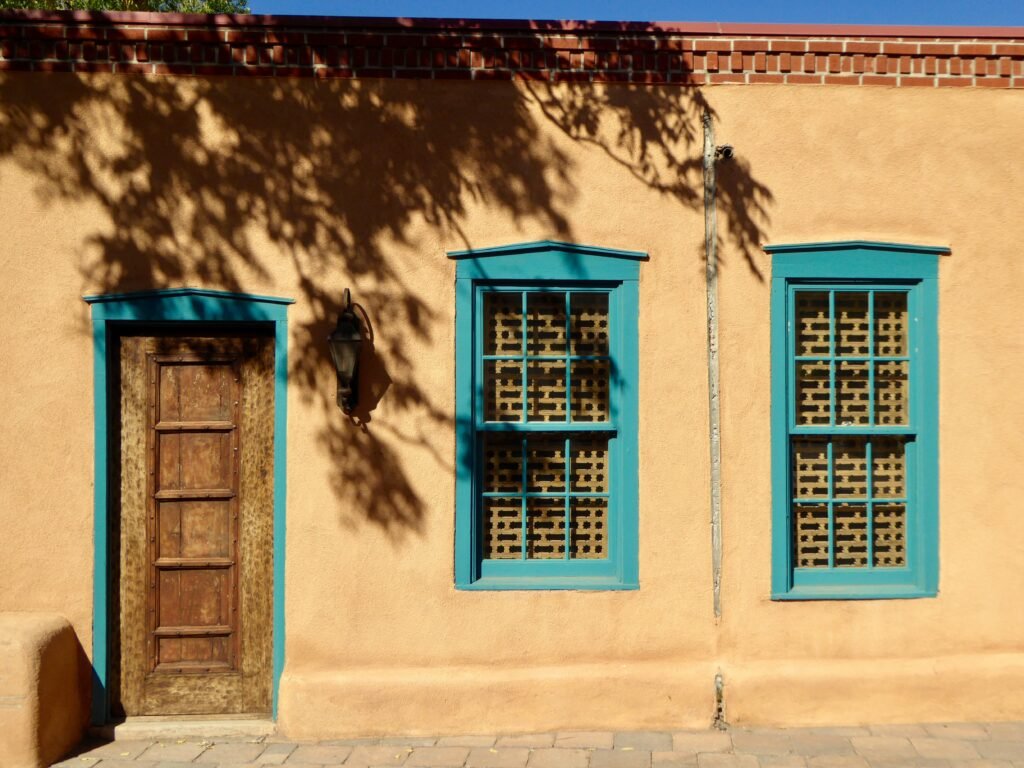
Keep main wall colors muted and earthy, then add contrast at doors, gates, and window frames. Turquoise is traditional in the region and appears in folklore as protective. Strong matches include Sherwin-Williams Drizzle (SW 9135) and Behr Maya Blue (M460-4). Oxblood and deep red—referencing dried-blood plaster and ristra red—are also historically correct and pair well with carved wood. Benjamin Moore Caliente (CC-62) is a compelling choice in this family.
Historic District Color Rules
Homes in historic districts—especially in Santa Fe, New Mexico—operate under legal color limits. The Santa Fe Historic Districts Ordinance restricts adobe and adobe-style stucco facades to a narrow band of earth tones: brown, tan, beige, and natural mud-plaster shades. White, gray, and bright colors are not allowed on primary wall surfaces. Every exterior repaint requires Historic Districts Review Board (HDRB) approval, including a physical on-wall sample and a brushed drawdown. Painting without approval can lead to fines up to $5,000 and an order to repaint. Confirm local ordinances before you buy paint.
Paint Comparison: Which Is Best for Your Adobe House?
The best choice depends on wall condition, budget, and the look you want to achieve.
- Limewash: Best for traditional aesthetics, historical authenticity, and maximum breathability. It is inexpensive but needs more frequent refreshing on weather-exposed exteriors.
- Mineral Paint (Potassium Silicate): Best for long-term exterior durability and UV stability. It remains vapor-open and can last 20-plus years, though initial cost is higher.
- 100% Acrylic Paint (Breathable): Best for sound, well-drained adobe exteriors where a conventional paint look is desired. It is widely available and cost-effective, but it requires verified breathability and meticulous back-rolling.
- Oil-Based Paint: Best where a thicker, dirt-resistant exterior finish is requested and a compatible breathable primer is used. It offers lower vapor permeability than limewash or mineral paint.
Common Mistakes to Avoid When Painting Adobe
- Applying waterproof or non-breathable products that trap moisture in the wall.
- Painting to hide drainage or moisture issues instead of correcting the source.
- Spraying without back-rolling, which leaves crevices uncoated.
- Using PVC or PVA primers that cause blistering.
- Painting over damp walls and triggering adhesion failure.
- Skipping crack repairs and surface prep.
- Putting interior formulations on exterior walls.
- Sandblasting to strip paint, which erodes adobe bricks.
- Overlooking historic district color requirements.
Frequently Asked Questions
Can I paint over existing acrylic paint on my adobe wall?
Avoid it if the existing layer is failing or not vapor-open. A breathable topcoat over a sealed film does not restore vapor flow. Remove the old layer, or at minimum score it heavily to create escape pathways for moisture.
What is the cheapest paint for an adobe house?
Limewash. You can make it from hydrated lime and water at very low cost, then tint with mineral pigments if desired.
Do I need to use a primer before painting adobe?
In most cases, yes. A breathable sealer or primer reduces dusting, evens absorption, and supports adhesion. Some mineral paints are self-priming, and limewash only needs a pre-dampened wall.
Final Thoughts
Painting adobe calls for a balance of appearance and building health. The material’s defining trait—porosity that manages moisture—must be preserved. Choose vapor-open systems such as limewash, mineral paint, or carefully vetted acrylics, and invest time in repairs, cleaning, and the right application method. Do that, and you protect the structure while finishing it in a way that respects the character of earthen construction and holds up over time.