
The Quick Rundown
- Start with a full edit before buying a single bin or shelf.
- Vertical wall space is the most underused asset in any garage.
- Zone your garage by activity type, not by item size.
- Wall-mounted shelving systems outperform freestanding units in almost every situation.
- Track systems handle awkwardly shaped items that shelves cannot.
- Pegboards are the most cost-effective tool organization solution available.
- Overhead ceiling storage is ideal for seasonal items used less than twice a year.
- Opaque bins keep the garage looking tidy when the door is open.
- Label everything, even if you think you will remember where it goes.
- The maintenance habit matters more than the initial organization.
A garage is one of the most misused rooms in any home. The average two-car garage in the United States is 400 to 440 square feet, yet a 2015 study by the UCLA Center on Everyday Lives and Families found that 75% of homeowners with two-car garages could not fit even one car inside because of clutter. The space that was meant to protect vehicles ends up storing broken equipment, forgotten holiday decorations, and boxes that were never unpacked after the last move.
The good news is that garage organization ideas do not require a full renovation or a large budget. Most garages are transformed by two moves: getting rid of what does not belong there, and using the vertical space that is already available. The rest is just choosing the right products for the right spots.
This guide covers everything from the initial edit to wall systems, overhead storage, tool organization, bike storage, and long-term maintenance. Whether the garage is a single-car space or a three-bay workshop, the principles are the same.
Start With the Edit, Not the Containers
The most common garage organization mistake is buying bins and shelves before deciding what stays. The result is an organized mess: everything has a container, but half of those containers hold items that should have been thrown away years ago.
Pull everything out of the garage before organizing it. Do this on a dry day with enough room to spread items across the driveway. Sort into four categories: keep, donate, trash, and belongs elsewhere. Be honest about the “belongs elsewhere” pile. A garage is not a second storage unit for the house.
Ask these questions for every item:
- Has this been used in the past 12 months?
- Is it in working condition?
- Does it have a specific purpose, or is it being kept “just in case”?
- Would it cost less than $20 to replace if it were ever needed again?
Anything that fails two or more of those questions should leave the garage. Abby Lawson of Abby Organizes, who has organized garages for years, puts it plainly: “Getting our garage from its horrendously disorganized state to the happy, organized place it is today was a serious labor of love.” The edit is where that labor starts.
Once the keep pile is established, measure the garage walls, ceiling height, and floor space before purchasing anything. Knowing the exact dimensions prevents the common problem of buying shelving that does not fit the available wall run.
The Zone System That Transforms a Garage
Organizing a garage by zone means grouping items by how and when they are used, not by what they look like or how big they are. A zone-based garage is faster to use and easier to maintain because everything in a given area serves the same purpose.
The most effective garage zones are:
- Automotive zone: Car care products, jumper cables, tire inflator, motor oil, windshield fluid. Keep this near the garage door or in a cabinet close to where the car parks.
- Lawn and garden zone: Mowers, trimmers, rakes, shovels, fertilizer, potting soil, garden hoses. Position this near the exterior door or side door that leads to the yard.
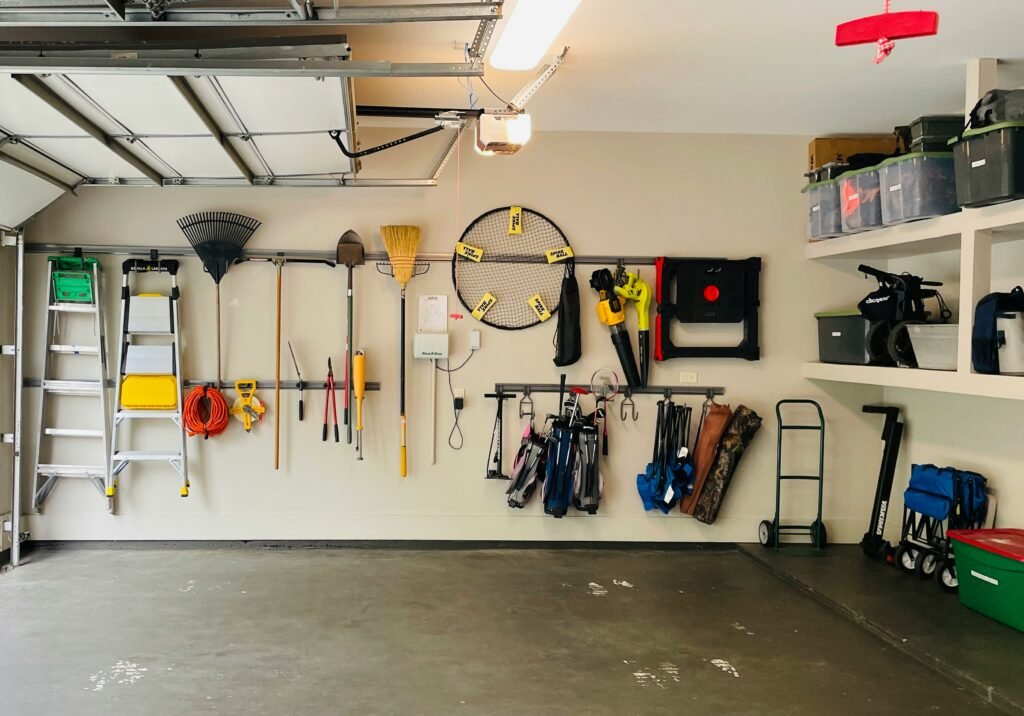
- Sports and recreation zone: Bikes, helmets, balls, bats, camping gear, fishing equipment. Wall hooks and track systems work best here because most of these items are oddly shaped.
- Workshop zone: Power tools, hand tools, hardware, workbench. This zone benefits most from pegboards and dedicated tool storage.
- Seasonal zone: Holiday decorations, seasonal clothing, camping gear used once a year. Overhead ceiling storage is the right home for this category.
- Household overflow zone: Bulk paper goods, extra cleaning supplies, non-perishable food storage. Freestanding metal shelving works well here.
The zones do not need to be perfectly separated by walls or dividers. The goal is that every item in the garage has a logical home that makes sense to everyone who uses the space.
Wall-Mounted Shelving Systems
Wall-mounted shelving is the single most impactful garage organization upgrade available. It takes items off the floor, uses vertical space that would otherwise go to waste, and creates a clean, organized look that freestanding shelves cannot match.
IKEA BOAXEL
IKEA’s BOAXEL system replaced the discontinued ALGOT system and is one of the most cost-effective wall-mounted options available. The system uses wall-mounted uprights with adjustable brackets, so shelf heights can be changed as storage needs shift. Metal shelf panels are available for heavy garage items, and the system can be extended horizontally across an entire wall. Abby Lawson, who used the predecessor ALGOT system across seven closets before installing it in her garage, notes that choosing BOAXEL over the Container Store’s Elfa system saved thousands of dollars on a full-garage installation.
Container Store Elfa
The Elfa system is the premium option in the wall-mounted shelving category. It uses a top-track mounting system that distributes weight across the wall more evenly than stud-mounted uprights, which makes it particularly well-suited for heavy tool storage or garages with concrete block walls. Kris Jarrett of Driven by Decor used Elfa throughout her garage transformation and describes the system as “completely customizable from floor to ceiling.” The tradeoff is cost: a full Elfa garage installation runs significantly more than BOAXEL.
ClosetMaid and Rubbermaid FastTrack
Both ClosetMaid and Rubbermaid’s FastTrack system are widely available at Home Depot and Lowe’s and offer a middle ground between BOAXEL and Elfa in terms of price and flexibility. FastTrack uses a single horizontal rail mounted to the wall, with hooks, baskets, and shelves that clip directly onto the rail. This makes it particularly good for garages where the stud spacing is irregular, since the rail spans across studs rather than requiring individual bracket mounting.
Track Systems for Awkwardly Shaped Items
Shelves are excellent for boxes, bins, and containers. They are poor at storing bikes, ladders, garden hoses, sports equipment, and anything else with an irregular shape. Track systems solve this problem.
A wall track system consists of horizontal rails mounted to the wall studs, with a range of hooks, baskets, and attachments that clip onto the rails. The key advantage is flexibility: the hooks can be repositioned in seconds without any tools, so the configuration can change as storage needs change.
Gladiator GearTrack is the most widely recommended track system for garages. The rails are made of steel and rated for significant weight loads, and the hook and accessory range covers bikes, ladders, garden tools, sports equipment, hoses, and power tools. Attachments designed specifically for bikes allow a standard road or mountain bike to hang vertically from the wheel, which takes up far less wall space than horizontal storage.
IKEA SKADIS is a pegboard-style track system that works well for lighter items: hand tools, spray bottles, cleaning supplies, and small accessories. It is not rated for the same loads as Gladiator but costs significantly less and is widely available.
The combination that works best in most garages is a wall-mounted shelving system for bins and boxes, paired with a track system for sports equipment and garden tools. The two systems complement each other and cover the full range of what a garage typically needs to store.
Pegboards for Tool Organization
A pegboard is the most cost-effective tool organization solution in any garage. A 4×8 sheet of standard pegboard costs under $30 at most hardware stores, and the hook and accessory range is extensive enough to accommodate everything from screwdrivers and pliers to power drills and extension cords.
The key to making a pegboard work long-term is to outline each tool’s position with a marker or paint. When a tool is removed and used, its silhouette on the board makes it obvious where it belongs when it is put back. This is the same system used in professional workshops and auto shops, and it works because it removes the decision-making from the return process.
Abby Lawson uses the IKEA SKADIS pegboard in her garage workstation to organize office supplies and cleaning products, noting that it is “cute and practical.” For heavier tools, a standard 1/4-inch pegboard mounted with 1-inch standoffs from the wall (to allow hooks to seat properly) is the better choice.
Pegboard mounting tips:
- Mount to wall studs, not drywall alone.
- Use 1-inch standoffs between the pegboard and the wall to allow hooks to engage properly.
- Apply a coat of paint or sealant if the garage is not climate-controlled, since moisture will cause standard pegboard to warp over time.
- Use locking pegboard hooks rather than standard hooks if tools are frequently removed and replaced, as locking hooks stay in place rather than pulling out with the tool.
Overhead Ceiling Storage
The ceiling of a garage is the most underused storage surface in the home. In a standard garage with 8-foot ceilings, there is typically 4 to 6 feet of clearance above the car roof, which is enough space to store bins, seasonal decorations, camping gear, and other items that are used infrequently.
Ceiling-mounted storage platforms are the most popular overhead solution. Products like the Fleximounts Overhead Garage Storage Rack and the Racor Ceiling Storage Platform mount directly to the ceiling joists and create a flat platform that can hold 400 to 600 pounds of evenly distributed weight. Standard platform sizes range from 4×8 feet to 4×6 feet, and adjustable drop rods allow the platform height to be set based on the vehicle clearance needed below.
Ceiling-mounted bike hoists are a separate category. A bike hoist uses a pulley system to lift a bike vertically to the ceiling and hold it there until needed. They are inexpensive (most cost between $20 and $40), easy to install, and free up significant floor and wall space. The Rad Cycle Products Bike Hoist and the Racor Ceiling Bike Lift are two of the most widely reviewed options.
The rule for overhead storage is simple: only items used less than twice a year belong up there. Anything accessed more frequently should be on a wall system or shelf where it can be reached without a ladder.
Garage Organization Ideas for Specific Items
Bikes
Bikes are one of the most space-consuming items in a garage. A single bike laid on the floor or leaned against a wall takes up 5 to 6 square feet of floor space. The same bike hung vertically on a wall hook takes up less than 1 square foot.
Wall-mounted vertical hooks are the simplest and cheapest solution. A single hook rated for 50 pounds mounts to a wall stud and holds the bike by the front wheel. Two hooks positioned side by side can hold two bikes in the same wall space a single horizontal bike would occupy.
Track system bike attachments (such as the Gladiator GearTrack bike hook) allow the bike position to be adjusted along the rail, which is useful in garages where multiple bikes need to share a wall run.
Ceiling hoists are the best option when wall space is limited or when the bikes belong to children who cannot reach a wall-mounted hook easily.
Garden Tools
Long-handled garden tools (rakes, shovels, brooms, hoes) are awkward to store because they are tall, heavy at one end, and prone to falling over when leaned against a wall. A wall-mounted tool rack with spring-loaded clips holds each tool securely by the handle and keeps them upright without any leaning.
For smaller garden tools (trowels, pruners, gloves), a pegboard near the garden zone or a wall-mounted bin system keeps them visible and accessible without taking up shelf space.
Sports Equipment
A dedicated sports zone with a combination of wall hooks, bins, and a ball storage rack prevents sports equipment from spreading across the garage floor. Ball storage racks (either wall-mounted or freestanding) hold basketballs, soccer balls, and footballs in a compact footprint. Helmet hooks keep helmets off the floor and visible. A bin for each sport (one for baseball, one for soccer, one for tennis) makes it easy for kids to find what they need and put it back.
Power Tools
Power tools belong in a dedicated workshop zone, either in a rolling tool chest, wall-mounted tool cabinet, or on a pegboard. The rolling tool chest is the most flexible option because it can be moved to wherever the work is happening. A wall-mounted cabinet with locking doors is better for garages where security is a concern or where children have access to the space.
Freestanding Metal Shelving for Bulk Storage
Not every garage has walls suitable for mounted shelving. Concrete block walls, rented garages, and garages with limited stud access all benefit from freestanding metal shelving units instead.
Gladiator Premier Series steel shelving is the most widely recommended freestanding option for garages. The units are made of steel rather than the particleboard or plastic used in cheaper shelving, which means they do not warp under weight or in humid conditions. Each shelf is rated for 250 pounds, and the units can be bolted together side by side for a continuous shelving wall.
Abby Lawson, who uses Gladiator metal shelves in her basement, notes that the upfront cost is higher than plastic alternatives but that “I never have to worry about them giving out or falling down.” In a garage environment where shelves may hold heavy bins, tools, and automotive supplies, that durability matters.
Wire shelving units are a cheaper alternative that still outperform plastic shelving in terms of durability. The open wire design allows air circulation (which reduces moisture buildup) and makes it easy to see what is on each shelf without pulling bins forward.
Garage Organization on a Budget
A full wall-mounted shelving system with track accessories and overhead storage can cost $500 to $2,000 or more depending on the garage size and products chosen. For garages where budget is a constraint, the following changes deliver the most impact per dollar spent.
| Product | Approximate Cost | Impact |
| Wall-mounted tool hooks (pack of 6) | $10-$15 | Gets bikes, ladders, and hoses off the floor |
| Freestanding wire shelving unit | $40-$80 | Creates immediate vertical storage |
| IKEA SKADIS pegboard (22×22 inch) | $15-$25 | Organizes hand tools and small accessories |
| Plastic storage bins with lids (6-pack) | $25-$40 | Standardizes bin sizes for stackable storage |
| Label maker or label tape | $15-$30 | Makes the system maintainable long-term |
| Ceiling bike hoist | $20-$40 | Removes bikes from floor without wall mounting |
The highest-impact single change in any garage is getting items off the floor. Even a $40 wire shelving unit creates enough vertical storage to clear a significant amount of floor space, which makes the garage feel larger and easier to navigate.
Common Garage Organization Mistakes
Buying storage products before editing. Containers and shelves bought before the edit end up storing items that should have been thrown away. The edit always comes first.
Ignoring vertical space. Most garages have 8 to 10 feet of wall height, but storage is concentrated in the bottom 4 feet. Using the full wall height doubles or triples the available storage capacity.
Using plastic shelving in a humid garage. Plastic shelving warps under weight and in humid conditions. Metal or wire shelving is the right choice for a garage environment.
Storing seasonal items in accessible spots. Christmas decorations and camping gear used once a year should not occupy prime wall or shelf space. Overhead ceiling storage is the right home for anything used fewer than twice a year.
Skipping labels. A garage organization system without labels relies on memory. Labels make the system usable by every member of the household, including anyone who did not set it up.
Mixing zones. Storing automotive supplies next to garden tools next to sports equipment creates a garage where nothing is easy to find. Zones work because they group items by use, not by size or shape.
Organizing without a maintenance plan. A garage that is organized once and never maintained will return to its original state within six months. A weekly 5-minute reset and a twice-yearly full audit are the two habits that keep a garage organized long-term.
Garage Organization Products Worth Buying
IKEA BOAXEL wall-mounted shelving system: The best value wall-mounted shelving system for a full garage installation. Adjustable, durable, and significantly cheaper than premium alternatives.
Gladiator GearTrack wall track system: The most versatile track system for garages. The hook and accessory range covers bikes, ladders, garden tools, and sports equipment. Steel construction rated for heavy loads.
Fleximounts Overhead Garage Storage Rack: The most widely reviewed ceiling storage platform. Adjustable drop rods, 600-pound weight capacity, and available in multiple sizes.
IKEA SKADIS pegboard: The best value pegboard for light tool and accessory organization. Magnetic accessories, hooks, and containers are available separately.
Gladiator Premier Series steel shelving: The best freestanding shelving option for garages. Steel construction, 250-pound per shelf rating, and available in multiple sizes.
Racor Ceiling Bike Lift: A simple, inexpensive pulley system that lifts a bike to the ceiling and holds it there. Rated for 50 pounds and installs in under 30 minutes.
OXO Good Grips wall-mounted tool rack: Spring-loaded clips hold long-handled garden tools securely without wall anchors. Holds up to five tools in a 12-inch wall space.
Maintaining a Garage Organization System
The organization system is only as good as the habits that maintain it. A garage that is organized once and never maintained will drift back toward clutter within a few months.
The daily reset takes less than five minutes. At the end of any day when the garage was used, put every item back in its zone. Do not leave items on the floor or workbench overnight.
The one-in-one-out rule prevents accumulation. Any time a new item enters the garage, one existing item leaves. This applies to tools, sports equipment, automotive supplies, and everything else.
The twice-yearly audit is a deeper review. Twice a year (spring and fall work well), pull everything out of the garage, check for items that are no longer used, and reorganize any zones that have drifted. This is also the time to rotate seasonal items into and out of overhead storage.
The “does it belong here” question applies to every item that enters the garage. A garage is not a second storage unit for the house. Items that belong inside the house should go inside the house.
Garage Organization Ideas for Specific Situations
Renters
Renters cannot drill into walls or install permanent wall-mounted systems. The best solutions for rented garages are freestanding metal shelving units, freestanding pegboard frames (which stand on their own without wall mounting), and freestanding tool chests. Ceiling-mounted bike hoists can be installed in most rental garages since they mount to ceiling joists and the holes are small enough to patch when moving out.
Shared Garages
A garage shared between two households or two people with different storage needs benefits from clearly defined zones with visible boundaries. Color-coded bins (one color per person or household) make it immediately clear what belongs to whom. Labeling is more important in a shared garage than in a single-household garage.
Garages That Double as Workshops
A workshop garage needs a dedicated workbench with good lighting, a pegboard for tool organization, and a rolling tool chest for power tools and hardware. The workbench should be positioned near an electrical outlet and, where possible, near a window for natural light. The rest of the garage organization follows the same zone principles, with the workshop zone given priority placement near the workbench.
Small One-Car Garages
A one-car garage with limited floor space benefits most from aggressive vertical storage. Wall-mounted shelving from floor to ceiling on every available wall, overhead ceiling storage for seasonal items, and track systems for bikes and garden tools can create enough storage capacity for a full household’s needs in a 200-square-foot space. The floor should be kept as clear as possible, with only the car and any rolling equipment (mowers, tool chests) occupying floor space.
Frequently Asked Questions
What is the best garage organization system?
Wall-mounted shelving combined with a track system covers the majority of garage storage needs. IKEA BOAXEL is the best value option for shelving; Gladiator GearTrack is the most versatile track system. The right combination depends on the garage size, wall type, and what needs to be stored.
How do I organize a garage with no wall space?
Freestanding metal shelving units, ceiling-mounted storage platforms, and freestanding pegboard frames are the best options when wall space is limited or unavailable. Overhead storage is particularly valuable in garages where the walls are occupied by windows, doors, or utility panels.
How much does it cost to organize a garage?
A basic garage organization with freestanding shelving, bins, and hooks costs $100 to $300. A mid-range installation with wall-mounted shelving and a track system costs $400 to $800. A full premium installation with Elfa or custom cabinetry can cost $2,000 to $5,000 or more.
How do I keep a garage organized long-term?
A daily 5-minute reset, a one-in-one-out rule for new items, and a twice-yearly audit are the three habits that keep a garage organized. The system itself matters less than the habits around it.
What should not be stored in a garage?
Propane tanks should not be stored inside an attached garage. Flammable liquids should be stored in a metal safety cabinet. Food should not be stored in a garage unless it is in airtight, pest-proof containers. Electronics and anything sensitive to temperature extremes should be stored inside the house.
How do I organize a garage on a small budget?
Start with a wall-mounted tool hook pack ($10-$15), a freestanding wire shelving unit ($40-$80), and a label maker ($15-$30). These three purchases address the most common garage problems (items on the floor, no vertical storage, no labeling) for under $130.