The Quick Rundown
- A UCLA study found that people living in cluttered homes had elevated cortisol levels throughout the entire day, not just at peak stress moments.
- The single most impactful first step is a full edit: pull everything out, then decide what stays.
- Slim velvet hangers can recover up to 30% more hanging space compared to standard plastic ones.
- Organizing by color within each clothing category creates a boutique-like effect and makes gaps in your wardrobe immediately visible.
- Closet systems like IKEA PAX, The Container Store Elfa, and ClosetMaid SuiteSymphony cover a wide range of budgets and closet sizes.
- Vertical space is almost always underused: a second hanging rod, stacked bins, and over-door organizers can double usable storage.
- Shelf dividers, labeled bins, and drawer inserts are the tools that keep a closet organized long after the initial setup.
- A well-organized closet is not about having the most storage. It is about having the right storage for how you actually get dressed.
Why Your Closet Keeps Getting Messy (and What to Do About It)
Most closets do not fail because of a lack of space. They fail because the storage does not match the behavior.
A single rod and one shelf, the default setup in most builder-grade closets, forces every item into the same format regardless of what it is. Shoes pile up on the floor. Sweaters collapse off the shelf. Bags get buried behind coats. The result is a space that looks chaotic within days of being “organized.”
The fix is not buying more bins. The fix is rethinking the structure first, then adding the right tools for the way you actually use the space.
Research from UCLA’s Center on Everyday Lives of Families found that women in cluttered homes showed elevated cortisol throughout the day, a pattern not seen in women who described their homes as restful and restorative. The closet is often the first thing you interact with in the morning and the last at night. Getting it right has a measurable effect on how the rest of your day feels.
Step One is Always the Edit
No organization system works on top of clutter. Before buying a single bin or installing a single shelf, pull everything out.
Allison Finn of Reclaim Professional Organizing puts it plainly: “Edit your wardrobe, keep items you wear and feel good in, and use bins wherever possible. This ensures the space stays tidy.” The edit is not a one-time purge. It is the foundation the rest of the system sits on.
Professional organizer Meaghan Kessman recommends making three piles: keep, donate or sell, and discard. The key is honesty. “Ask yourself if you’ve worn the item in the last 90 days or expect to wear it in the next 90,” says Tina Priestly, founder of Ready, Set, Refresh!. “Except in the case of seasonal items, if the answer is no, it’s time to let it go.”
For items you are genuinely undecided about, Shira Gill, author of Minimalista, uses what she calls the “backwards hanger” trick. At the start of a season, turn all hangers backwards. Anything still backwards at the end of the season has not been worn and should be reconsidered. No extensions, no exceptions.
Essense Hill of Essense of Closets adds one more rule: “If you’re not actively wearing it on your body, it shouldn’t be in your closet. Keepsakes can be stored elsewhere.” That means college memorabilia, wedding accessories, and anything else that belongs in long-term storage should leave the closet entirely before the organizing begins.
Step Two is Choosing Your Organization Method
Once the edit is done, you need a system. There is no single right answer, but there are three approaches that consistently work.
By type and color. Group items by category first, then sort within each category by color from light to dark. Shira Gill describes the effect: “Light to dark within each group makes gaps and redundancies visible immediately and creates a boutique-like effect that makes you actually want to open your closet.” Patterns go at one end to give the eye somewhere to rest. This method is particularly effective for people who shop by color or who want the closet to look polished.
By zone. Organize around how you actually get dressed. Courtney Cummings of The Stylish Organizer explains: “If you always wear a cami with a blazer, put those items together. If you always wear a dress with a hat, put those items together.” Zones reduce decision fatigue because everything you need for a given outfit or occasion is already in the same place.
By frequency of use. Items you reach for daily go at eye level and arm’s reach. Less-worn pieces go to the top shelf or the back of the closet. Shira Gill frames it ergonomically: “Most people organize aesthetically instead of ergonomically, and then wonder why they always reach for the same things.” Your most-worn 30% should be the easiest to access.
Most well-organized closets use a combination of all three. The color method handles the visual side. Zones handle the practical side. Frequency of use handles the ergonomic side.
The Best Closet Organization Ideas by Category
Hanging Clothes
The single most impactful swap you can make is replacing bulky plastic or wire hangers with slim velvet ones. Kris Jarrett of Driven by Decor tested this firsthand when moving from a large walk-in to a small shared closet: “I swapped out our hangers for slim velvet hangers and was amazed by how much more hanging space it gave us.” The difference is not marginal. Slim velvet hangers are roughly 5mm thick compared to 12-15mm for standard plastic, which translates to a real increase in hanging capacity.
Essense Hill of The Home Edit is equally direct: “Huggable hangers, no question. They make everything look more streamlined.” She also pushes back on the common belief that sweaters should never be hung. “I hear it all the time: ‘I thought you weren’t supposed to hang sweaters!’ But huggable hangers will treat them nicely. So if there’s space, I’m hanging everything. Only when I run out of room do I start folding.”
For a closet with limited hanging length, a second hanging rod installed below the first one is one of the most effective upgrades available. It doubles the hanging capacity for shorter items like shirts, blazers, folded pants, and skirts without requiring any structural changes.
Folded Clothes
Folded items belong on shelves or in drawers, and they stay organized only when they have defined boundaries. Shelf dividers are the tool most people overlook. For standard wood or melamine shelves, acrylic shelf dividers clip onto the shelf edge and create separate columns for sweaters, sweatshirts, and folded bags. For wire shelving, wire dividers with pressure-mounted prongs grip the shelf slats and hold their position without adhesive.
Inside drawers, expandable drawer dividers keep rows of folded clothing contained and categorized. The Home Edit recommends these specifically for preventing the slow collapse that happens when folded items are stacked without boundaries.
Shoes
Clear shoe boxes are the gold standard for shoe storage, and Essense Hill has used them since her first professional closet job. “My favorite shoe storage solution of all time is the clear shoe boxes from The Container Store. I’ve been using them since my very first closet and they’ve never failed me.” The hinged-front versions allow access without unstacking, which matters when you are getting dressed in a hurry.
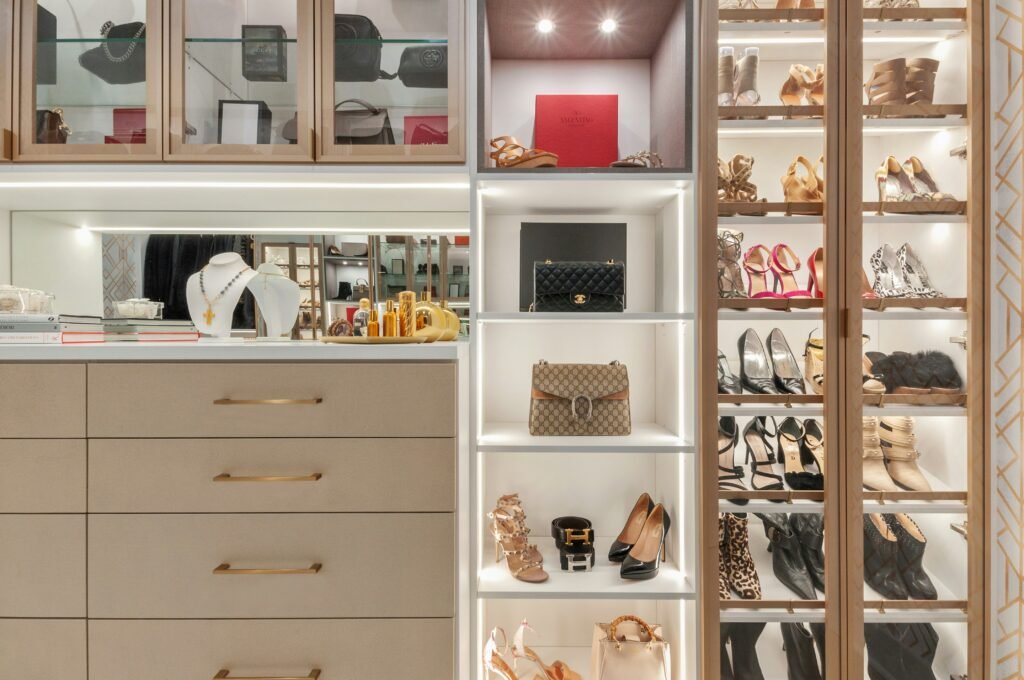
For shoes that do not fit in boxes, display them on a shelf using clear risers to create a staggered, boutique-style look. Over-door shoe organizers work well for flats and sneakers. Stackable clear bins work for bulkier footwear. The bottom of the closet is prime real estate for shoes, but only if the floor is organized. Shoes left loose on the floor are the fastest way to undo an otherwise tidy closet.
Bags and Accessories
Bags should be visible. “The more you see them, the more you use them,” says Essense Hill. “That’s the whole point. You bought them to wear them.” Handbags displayed on a shelf or hung on hooks are far more likely to be used than bags buried in a bin. For dust protection without sacrificing visibility, clear display boxes keep bags accessible and protected at the same time.
For belts and ties, a dedicated hanger organizer keeps them in the same section as the items they pair with. Essense Hill explains the logic: “It’s just like retail. When everything is categorized together, it’s easier to find what you need while putting an outfit together.” Scarves loop neatly through a multi-loop scarf organizer, which holds 20 or more without taking up meaningful space.
Jewelry is best stored in drawer compartment trays rather than over-door organizers. “You know those over-the-door jewelry organizers? No one is really taking the time to unhook a necklace or undo their earrings to hang them up every single day,” says Essense Hill. Drawer trays with separate sections for earrings, rings, bracelets, and necklaces are faster to use and easier to maintain.
Hats deserve their own wall. A row of hooks turns a hat collection into a display piece and keeps every hat visible and accessible. Hat stands and clear display boxes work for more structured hats that need to hold their shape.
Seasonal and Overflow Items
The top shelf of a closet is ideal for items that do not need daily access: extra bedding, seasonal clothing, and bulky accessories. Vacuum storage bags compress pillows and blankets to a fraction of their original size. Labeled fabric bins or clear stackable boxes keep seasonal clothing dust-free and easy to identify. In humid climates, a desiccant pack inside each storage bag prevents moisture buildup during warm months when the upper shelf can get significantly warmer than the rest of the closet.
Closet Organization Ideas by Closet Type
Small Reach-In Closets
A reach-in closet with a single rod and shelf has more potential than it looks. The key is attacking vertical space from every angle.
Install a second hanging rod below the existing one for short items. Add a shelf above the existing shelf for bins and baskets. Use an over-door organizer on the inside of the closet door for shoes, accessories, or cleaning supplies. Mount hooks on the side walls for bags, belts, and scarves. Use the floor for a shoe rack or a small set of drawers.
Houston-based interior designer Lauren Ashley describes organizing a small closet as “like a game of Tetris.” Every inch has a role. “Installing shelves higher or adding hanging rods above other items for shoes, bags, or even folded clothes can be great ways to maximize vertical space,” she says. “I’ve used adjustable hanging closet bars for the lower half of the closet. This doubles the capacity for storage and lets you hang items like pants or tops on the bottom row.”
Tina Priestly adds one practical tool that most people forget: “Keep a step ladder within reach of your closet to access those higher shelves.” Upper shelves that are difficult to reach tend to become dumping grounds. A step ladder makes them functional.
Walk-In Closets
A walk-in closet gives you the luxury of space, but it also gives you more room to make organizational mistakes. The most common one is treating the entire space as a single zone rather than dividing it into dedicated areas.
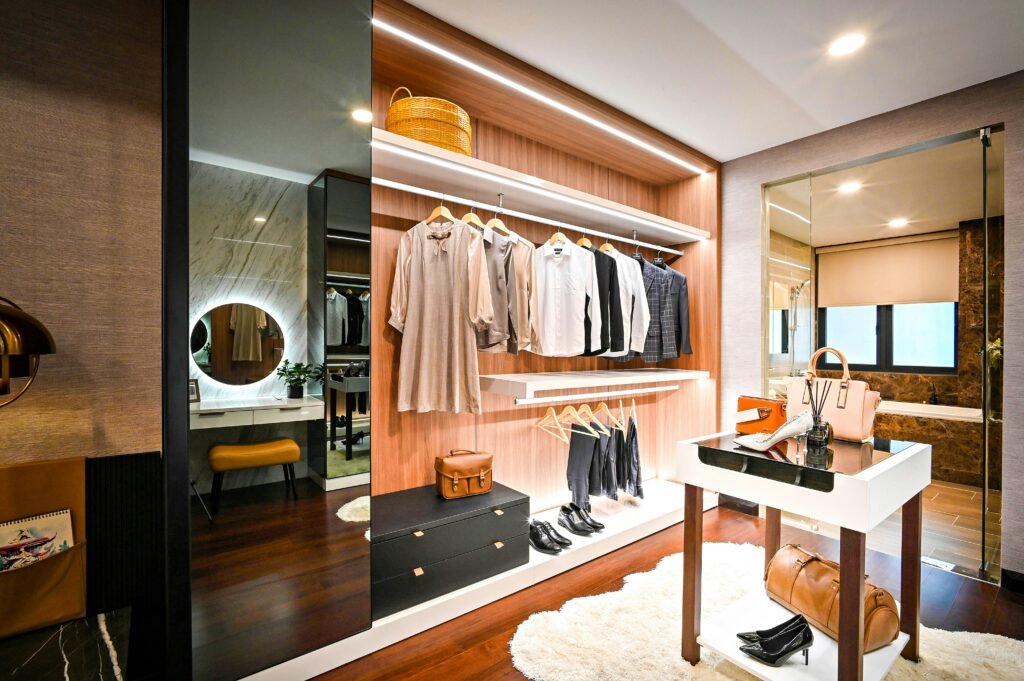
Map the closet before adding anything. Assign one wall or section to hanging clothes, one to shelving and folded items, and one to shoes and accessories. If the closet is large enough, a central island with drawers provides additional storage and a surface for laying out outfits.
Color-coding hanging clothes is particularly effective in a walk-in because the full wardrobe is visible at once. Shira Gill’s light-to-dark method within each category creates a visual inventory that makes it easy to see what you own, what you are missing, and what you have too much of.
Bedroom Closets
Bedroom closets serve a specific purpose: they need to support the morning routine and the end-of-day routine without friction. That means the items you reach for most often need to be the easiest to access.
Organize by frequency of use first, then by type and color within each frequency tier. Work clothes go at eye level. Weekend clothes go slightly lower or to the side. Rarely worn items go to the top shelf or the back. This structure means you are never digging through the closet to find what you need on a Tuesday morning.
Entryway and Coat Closets
An entryway closet has a different job than a bedroom closet. It needs to handle coats, shoes, bags, and the miscellaneous items that accumulate near the front door. The biggest mistake is using it as overflow storage for everything that does not have a home elsewhere.
Keep only what belongs near the entry: outerwear, shoes worn regularly, bags in active rotation, and a small bin for accessories like hats and gloves. A row of hooks at different heights handles coats and bags. A shoe rack or cubbies at the bottom handles footwear. A small shelf or bin near the door handles keys, sunglasses, and everyday carry items.
Linen Closets
Linen closets work best when items are grouped by room or function: one shelf for bathroom towels, one for bed linens, one for cleaning supplies. Folded towels stack neatly when they are all the same size; if yours are mismatched, roll them instead of stacking to create a more stable arrangement.
Labeled bins on upper shelves keep extra toiletries, first aid supplies, and seasonal items contained. Clear bins are preferable to opaque ones because you can see what is inside without pulling everything out.
Closet Organization Systems Worth Knowing
For anyone doing a full closet overhaul, a modular closet system is the most efficient way to maximize space. The three most widely used options cover a range of budgets and installation approaches.
| System | Type | Best For | Price Range |
| IKEA PAX | Freestanding wardrobe frames | Walk-ins, large spaces, renters | $150-$800+ |
| Container Store Elfa | Wall-mounted, adjustable | All closet types, maximum flexibility | $200-$2,000+ |
| ClosetMaid SuiteSymphony | Wall-mounted, laminate | Mid-budget, DIY-friendly | $100-$600+ |
| Easy Track | Wall-mounted, laminate | Budget-friendly, DIY-friendly | $80-$500+ |
| Modular Closets | Freestanding modular | Walk-ins, renters, no drilling | $200-$1,500+ |
The IKEA PAX system uses wardrobe frames with customizable interiors. You add hanging rods, drawers, shelves, and specialized inserts to build out the interior. It is a good fit for walk-in closets and for renters who cannot mount systems to walls.
The Elfa system from The Container Store works differently. A top track mounts along the length of the closet wall, and vertical rails hang from it. Every component, including shelves, drawers, hanging rods, and baskets, clips onto those rails and can be repositioned without tools. It is the most flexible system available and works in reach-ins, walk-ins, and everything in between.
ClosetMaid SuiteSymphony and Easy Track are wall-mounted laminate systems that sit in the middle of the market. Both are available at major home improvement stores and are designed for DIY installation. ClosetMaid has a slight edge in finish quality; Easy Track has a slight edge in price.
Closet Organization Products That Earn Their Place
Beyond the system itself, a handful of individual products consistently show up in well-organized closets.
Slim velvet hangers: The single most impactful purchase for any closet. Uniform hangers make the hanging section look intentional and recover a meaningful amount of hanging space.
Clear shoe boxes with hinged lids: Stackable, visible, and accessible without unstacking. The Container Store version is the most cited by professional organizers.
Acrylic shelf dividers: Clip onto any standard shelf and create defined columns for folded items. They prevent the slow collapse that happens when stacks are left unsupported.
Over-door organizers: Use the inside of the closet door for shoes, accessories, or small items. A well-chosen over-door organizer can add the equivalent of a full shelf without taking up any floor or wall space.
Labeled fabric bins: For the top shelf, seasonal storage, and anything that does not need to be visible. Labels are non-negotiable. Unlabeled bins become mystery boxes within weeks.
Expandable drawer dividers: Keep folded clothing in defined rows inside drawers. They work in any drawer size and prevent the drawer from becoming a jumbled pile.
Clear stackable bins: For linen closets, entryways, and anywhere you need to see the contents at a glance. Uniform bins make a shelf look intentional rather than improvised.
Closet Organization Ideas on a Budget
A full closet system is not always necessary or affordable. These are the highest-impact changes you can make without spending much.
Swap the hangers first. A set of 50 slim velvet hangers costs under $20 and immediately changes how the closet looks and functions. This is the most cost-effective single upgrade available.
Add a tension rod below the existing hanging rod. A standard tension rod costs $10-$15 and doubles the hanging capacity for shorter items. No drilling, no installation, no permanent changes.
Use labeled shoeboxes instead of clear bins. If clear shoe boxes are out of budget, label the ends of regular shoeboxes and stack them. It is not as visually clean, but it is functional and free.
Install adhesive hooks on the side walls and the inside of the door. Command hooks hold bags, belts, scarves, and accessories without drilling. They are removable, which makes them ideal for renters.
Use a tension rod inside a cabinet or on the wall for hanging bags. A second tension rod mounted horizontally at the back of a shelf creates a hanging bar for purses, totes, and clutches.
Common Closet Organization Mistakes
Organizing without editing first. Buying bins and installing shelves before removing what does not belong guarantees that the closet will be cluttered again within weeks. The edit always comes first.
Choosing storage based on aesthetics rather than behavior. A beautiful wicker basket is useless if you never open it. Storage should match how you actually use the space, not how you want it to look in a photo.
Ignoring the door. The inside of a closet door is one of the most underused surfaces in any home. An over-door organizer, a row of hooks, or a mounted shoe pocket can add meaningful storage without touching the walls or floor.
Leaving the top shelf as dead space. The top shelf tends to become a dumping ground for items without a home. Labeled bins with specific purposes prevent this. If something does not have a bin, it does not belong on the top shelf.
Using too many different storage containers. A mix of different bins, baskets, and boxes in different sizes and colors creates visual noise that makes a closet feel chaotic even when it is technically organized. Stick to one or two container styles and sizes throughout.
Skipping labels. Labels are what make an organization system durable. Without them, bins and baskets become ambiguous, and items end up in the wrong place. Label everything, including shelves and sections, not just containers.
Organizing for the closet you want rather than the closet you have. Pinterest-worthy walk-in closets with custom built-ins are aspirational, but they are not the starting point. Work with the space you have, optimize it as much as possible, and upgrade incrementally.
Closet Organization Ideas for Specific Situations
Shared Closets
Divide the space clearly. Each person gets a defined section, and items do not cross over. If the closet is too small for both wardrobes, consider adding a secondary hanging rack in the bedroom or using under-bed storage for off-season items.
Kids’ Closets
Lower the hanging rod to a height children can reach on their own. Use picture labels on bins so younger children can identify where things go without reading. Keep the most-used items at the lowest accessible level. Add a second rod higher up for adult access to seasonal items or overflow storage.
Renters
Freestanding systems like IKEA PAX and Modular Closets require no wall mounting and leave no damage. Command hooks and adhesive strips handle accessories and bags. Over-door organizers work without any hardware. Tension rods add hanging space without drilling.
Small Apartments
When closet space is limited, the bedroom itself becomes part of the storage system. A freestanding garment rack handles overflow hanging. Under-bed storage boxes handle off-season clothing and bulky items. A pegboard on a bedroom wall handles bags, accessories, and small items that would otherwise take up closet space.
Maintaining a Closet Organization System
Getting a closet organized is one thing. Keeping it organized requires a few habits.
Put things back in their designated place immediately, not “later.” The “I’ll deal with it later” pile is where organization systems go to die. One item out of place is easy to fix. Twenty items out of place is a project.
Do a quick reset at the end of each week. Five minutes of straightening, returning items to their sections, and clearing any surfaces that have accumulated clutter is enough to prevent the slow drift back to chaos.
Revisit the edit twice a year, ideally at the seasonal transition points. As your wardrobe changes, your storage needs change too. What worked in January may not work in July.
When something new comes in, something old goes out. This one-in-one-out rule prevents the gradual accumulation that makes closets feel full even after a recent organization session.
Frequently Asked Questions
What is the most effective way to organize a closet?
Start with a full edit before touching any storage. Remove everything, decide what stays, then build a system around the items that remain. The most effective systems organize by frequency of use first, then by type and color within each section.
What are the best closet organization systems?
The Container Store Elfa is the most flexible and professional-grade option. IKEA PAX is the best value for walk-in closets. ClosetMaid SuiteSymphony and Easy Track are solid mid-budget options for DIY installation. Modular Closets works well for renters who cannot mount systems to walls.
How do I organize a small closet?
Add a second hanging rod for shorter items, use an over-door organizer on the inside of the door, install hooks on the side walls, and use the top shelf for labeled bins. Slim velvet hangers recover meaningful hanging space. Every surface, including the door, the floor, and the walls, is usable.
Should I hang or fold sweaters?
Fold heavy knit sweaters to prevent stretching. Lighter sweaters and cardigans can be hung on slim velvet hangers without damage. The deciding factor is the weight and construction of the fabric, not a blanket rule.
How do I keep my closet organized long-term?
Return items to their designated place immediately after use. Do a five-minute weekly reset. Edit the wardrobe twice a year at seasonal transitions. Follow a one-in-one-out rule when adding new items.
What should not be stored in a closet?
Items that do not belong to the closet’s primary function: keepsakes, sentimental items, paperwork, tools, and anything that has not been used in over a year. These items belong in long-term storage elsewhere, not taking up prime closet real estate.