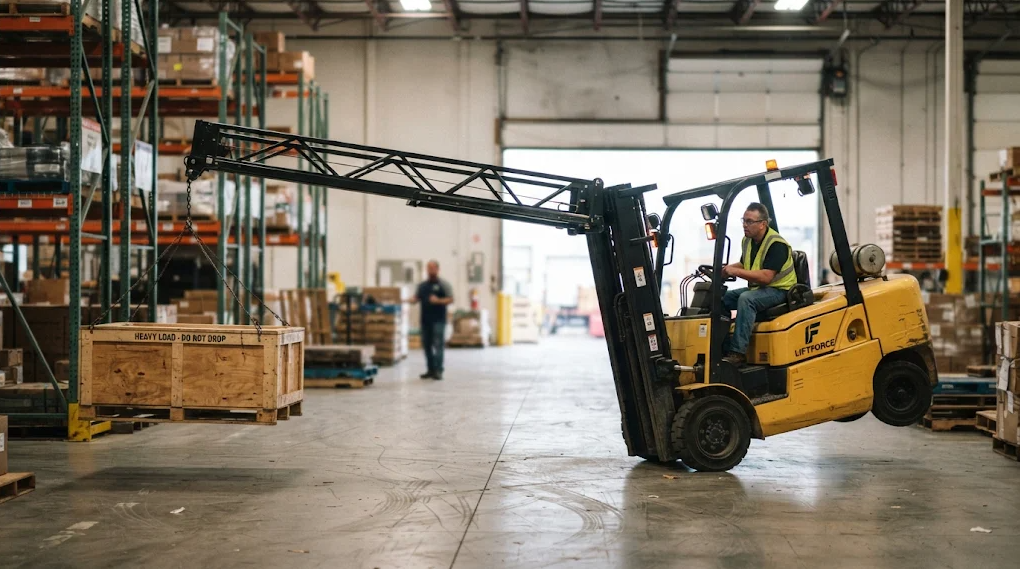
In warehouses, yards, and construction sites across Canada, the forklift is often the strongest machine on the property, yet it only handles pallets until someone changes the tool. A telescoping jib crane that slides onto the forks turns it into a hoist for engines, equipment, and awkward loads. The catch is one every operator should know before the first lift: a forklift boom loses capacity as it reaches farther out.
Leverage Does the Damage
The TMG-FJC55T lists 5,500 pounds at the first position and 1,650 pounds when fully extended. The load does not change, so the difference is leverage. Think of holding a bucket of water close to your chest versus at arm’s length. The weight is the same, but the farther it sits from your body, the harder your arm works. A longer boom multiplies the turning force on the forks, and the rating falls to less than a third of its maximum. That is why a forklift boom is described by two numbers, never one.
Reading the Adjustment Holes
The boom adjusts manually from 31 to 77 inches, with multiple adjustment holes for setting the hook position, listed from 47-1/4 to 77 inches. The hook itself measures 7-3/4 by 3-1/2 inches. Before lifting, set the position, pin it, and read the capacity for that setting. The adjustment holes are there so you can pick the shortest reach that still clears the obstacle. Guessing is the habit that causes damage, since the highest number on the label applies only to the shortest reach.
What It Does to the Forklift
The attachment weighs 200 pounds, and it sits ahead of the front axle. That shifts the load center forward and can reduce what the truck itself is rated to lift. The lower of the two ratings governs, so check the forklift’s data plate along with the attachment label. The forks should also match the slots: they are 6-3/4 by 2-1/4 inches, with 12 inches between fork centers, and the design fits most standard forklifts.
Habits That Keep Lifts Uneventful
Keep the load low while traveling, and never swing a hanging load or let it sway with the mast tilted. Keep people clear of the area under and around the load, and have a spotter if the operator’s view is blocked by the load itself. Use rated slings and shackles, and treat a forklift crane attachment as a lifting device, not a way around the pallet limit. Operators should be trained for the truck and the attachment.
Where the Attachment Earns Its Keep
The design targets warehouses, factories, and construction sites, where a pallet is the wrong shape for the load. Typical jobs include setting a machine onto its base, lifting a motor out of a housing, or moving a crate that has no fork pockets. A forklift attachment like this avoids hiring a separate crane for a ten-minute lift, which is where most of the value comes from. Its heavy-gauge steel construction suits repeated daily use.
Choosing between sizes comes down to how far you need to reach. For work that needs more reach or a higher rating, TMG Industrial also lists the TMG-FJC66 and TMG-FJC66P, rated for 6,600 pounds with booms from 30 to 138 inches.