Key Takeaways
- Breathability comes first for any coating on mud, adobe, or other earthen walls.
- Standard acrylic and latex films trap moisture in mud walls, leading to blistering, peeling, mold, and long-term structural harm.
- Limewash is the most affordable, traditional option, with vapor permeability of 75–85 perms.
- Silicate mineral paint has the longest service life, with well-documented examples lasting more than 100 years.
- Clay paint excels for interiors and period properties, with an SD value as low as 0.02 for exceptional moisture vapor transmission.
- Careful surface preparation, including crack repair and the right priming approach, is as important as the paint you choose.
- Natural coatings dry much lighter than they look when wet; always trial a small patch before full application.
- Interior and exterior conditions demand different products; do not swap them between locations.
Why Choosing the Right Paint for Mud Houses Matters
How Mud Walls Work and Why Breathability Is Critical
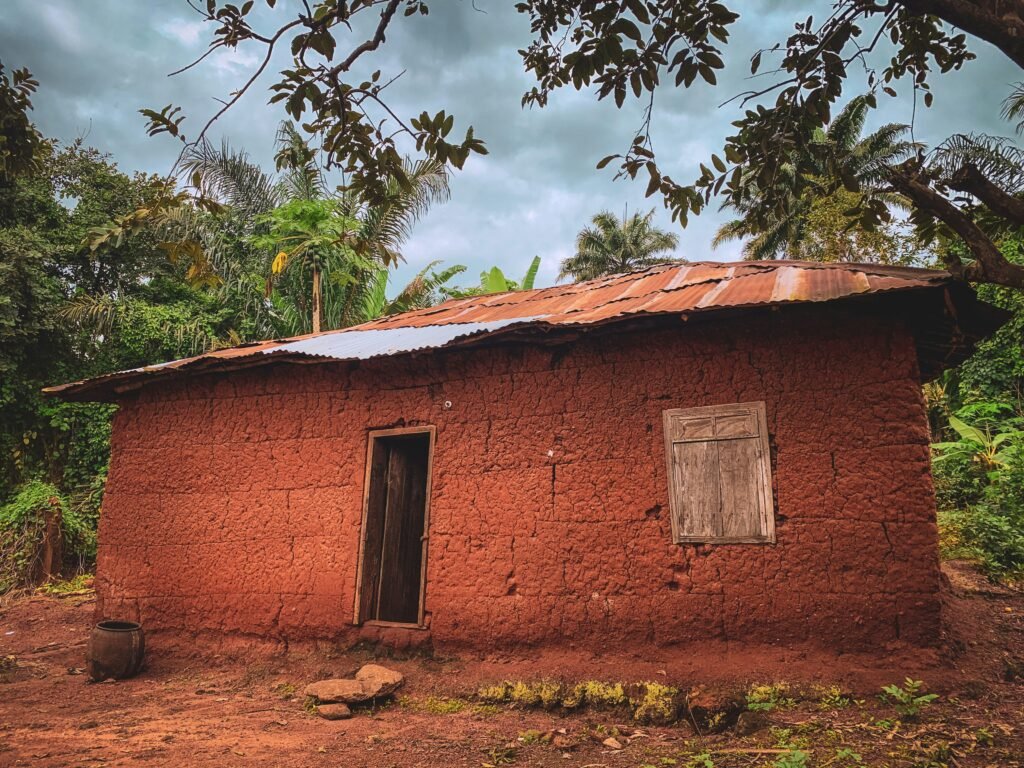
Mud, adobe, and rammed earth walls behave like moisture buffers rather than inert barriers. They constantly exchange water vapor with indoor and outdoor air as temperatures and humidity shift through the day and across seasons. That gentle uptake and release of moisture helps regulate indoor comfort and air quality. Far from a defect, this moisture cycling is a defining strength that has kept earthen buildings healthy and habitable for millennia in a wide range of climates.
The property that governs this exchange is vapor permeability. On earthen walls, it is non-negotiable. Any coating must allow water vapor to pass in both directions. When the wall can breathe, it retains strength, resists decay, and continues to perform as thermal mass. Block that flow, and you invite problems that begin at the surface and can progress into the wall core.
Every paint decision for a mud house should start with this principle. A product can boast durability, colorfast pigments, or weather resistance, but if it does not transmit moisture vapor, it does not belong on an earthen wall.
What Happens When You Use the Wrong Paint
When a non-breathable film covers a mud wall, the failure pattern is predictable and hard to undo. Moisture reaches earthen walls from wind-driven rain, groundwater wicking up from below grade, and indoor humidity that condenses within the wall. Under normal conditions, that moisture migrates through and evaporates at the surface. A sealed coating blocks the exit path.
Moisture then accumulates behind the film. Vapor pressure builds until it pushes the coating off the surface. Within months, blisters appear. As they rupture, wide sheets of paint can detach. The newly exposed areas remain damp and start to weaken, which speeds erosion. Mold and mildew thrive behind any film that remains. In severe cases, the soaked earthen material softens and loses cohesion, compromising the wall.
Builders and restoration specialists see this sequence time and again after acrylic or latex has been applied to adobe or mud brick. Often the paint looks fine for a year or two, then fails in large sections. Removing the failed coating and rehabilitating the wall usually costs more, and takes more labor, than a proper breathable finish would have at the outset.
Types of Paint That Work on Mud Houses
Limewash: The Traditional Choice
Limewash is a slurry of hydrated lime, or calcium hydroxide, and water mixed to a thin, milky consistency. Used on raw earth walls for centuries, it behaves differently from film-forming paints. Instead of building a separate layer, limewash soaks into the surface. Without a discrete film, there is nothing to trap moisture or peel away. Tested to ASTM E-96, limewash typically measures 75–85 perms, which is among the highest vapor permeability values you will find in wall finishes.
It adds other benefits. The high pH inhibits fungi, bacteria, and insects. During curing, it absorbs carbon dioxide and slowly reverts to calcium carbonate, hardening as it goes. It is nontoxic, contains no volatile organic compounds (VOCs), and is very inexpensive. One practitioner finished an entire interior wall for about three euros in materials.
The look is distinctive: soft, slightly luminous, and gently variegated in tone. Mineral pigments can tint it across a wide palette of earthy colors, though the base remains white or off-white. Expect it to dry far lighter than it appears in the bucket, so always test a sample and let it cure before selecting a color.
Against heavy weather exposure, limewash can need more frequent refreshes than mineral or synthetic options. Exteriors in driving rain may call for new coats every few years; protected interiors last longer. Since a refresher is fast and low-cost, maintenance is manageable for most projects.
Clay Paint: Natural and Breathable
Clay paint uses clay as both pigment and binder, creating an open, porous finish. Top-tier clay paints reach water vapor diffusion-equivalent air layer thickness (SD) values as low as 0.02, which indicates extremely low resistance to vapor movement, nearly the same freedom of movement as an uncoated wall. That makes clay paint a strong interior choice for mud walls, lime plaster, exposed stone, and heritage buildings where maintaining vapor balance matters.
Expect a soft, chalky, flat matte that complements the texture of earthen surfaces. Quality commercial formulations carry near-zero VOC ratings, with some as low as 0.01 g/L. Typical coverage ranges from 10–15 square meters per liter, with two coats giving even, full coverage.
Commercial options from brands such as Earthborne and COAT Paints arrive ready to use and are simple to apply. If you prefer to mix your own, recipes using kaolin clay, wheat paste, agricultural lime, and small amounts of gypsum and boric acid produce effective, low-cost coatings. DIY batches are especially attractive for large homes where buying pre-mixed paint would be expensive.
Silicate Mineral Paint: The Long-Term Solution
Silicate mineral paint, often called potassium silicate paint, offers the most advanced, longest-lasting finish for earthen and mineral substrates. Its binder, potassium water glass, does not create a surface film. Instead, it reacts chemically with a mineral base through silicification, forming a bond within the substrate itself. Because the coating becomes part of the wall, it cannot peel or blister as a separate layer would.
Vapor permeability matches or exceeds limewash, with KEIM’s Mineral Masonry Paint recording 80–85 perms in ASTM E-96 testing. Durability stands in another league. The city hall in Schwyz, Switzerland received silicate paint in 1891; the coating remained intact well into the twentieth century. Service lives beyond 100 years are recorded in historical use, not just marketing brochures.
Its inorganic binders are inherently stable under ultraviolet (UV) light, so colors resist fading and chalking far better than acrylics. The high alkalinity of the cured surface suppresses algae and fungal growth without added biocides, and the non-static surface tends to shed dirt, keeping facades cleaner between maintenance cycles.
Proper bonding requires a mineral or siliceous base: earthen plaster, lime plaster, masonry, and concrete are compatible. You will find two main product types. Pure silicate arrives as a two-part system mixed on site, while dispersion silicate is a single-component product containing a small fraction of organic binder for easier application. Sol-silicate blends, developed in the early 2000s, broaden compatibility to some non-mineral plasters. The main drawback is higher upfront cost compared to limewash or clay paint, though multi-decade lifespans make the lifetime cost attractive.
Vapor-Permeable Masonry Paint: A Practical Middle Ground
If you want a familiar paint experience without sacrificing breathability, look to specialty vapor-permeable masonry coatings. Products in this class, including the Colourcoat system from Grimes and Sons, are formulated for direct application to mudbrick and earthen render. They pass water vapor while delivering color, weathering resistance, and a more uniform surface than limewash typically provides. A compatible primer or render additive is often part of the system to improve adhesion and consolidate friable substrates.
Elastomeric Paint: When and Why to Consider It
Elastomeric coatings are thick, flexible films designed to stretch with substrate movement and bridge hairline cracks. Products such as BEHR Premium Elastomeric Masonry, Stucco and Brick Paint appear on some adobe projects. Even so, elastomerics breathe far less than limewash, clay paint, or silicate mineral paint, and on raw earthen walls they can trap moisture to risky levels.
Reserve elastomerics for cement-stabilized adobe or mud brick, where Portland cement already reduces vapor permeability and where crack-bridging can offer a real benefit. On unstabilized earthen walls, the loss of breathability usually outweighs any gain.
Paints to Avoid on Mud Walls
Standard Acrylic and Latex Paints
Conventional acrylic and latex paints cure into a continuous plastic-like film. While that film blocks liquid water effectively, it also blocks the outward flow of water vapor from within the wall. Moisture accumulates, pressure builds, and the coating ultimately gives way in the blistering-and-peeling pattern described earlier.
Some tradespeople report acceptable results with 100% acrylic on exterior adobe under very controlled conditions: a sound and completely dry wall, thorough cleaning, and back-rolling rather than spray-only application. Even then, it is a compromise, and long-term results lag behind breathable systems. For new work, or for any wall with a moisture history, avoid acrylic and standard latex altogether.
Oil-Based Gloss and Enamel Paints
Oil-based gloss and enamel paints create the same kind of impermeable layer as acrylics, trapping moisture behind the surface. They also release high levels of VOCs into indoor air, which runs counter to the low-VOC environments many earthen homes aim to maintain. There is no appropriate use case for oil-based gloss or enamel on raw mud or adobe.
Interior vs. Exterior Paint for Mud Houses
Painting Interior Mud Walls
Interiors are protected from rain and direct UV, so you have more flexibility and less need for weather additives. Clay paint is a standout inside: highly breathable, very low in VOCs, and naturally matte, ideal for highlighting the texture of earthen walls. Limewash performs well indoors too and brings the added benefit of antibacterial behavior, which suits kitchens, bathrooms, and utility rooms.
Prioritize VOC content for interiors. Many people choose earthen construction for healthier indoor environments; introducing high-VOC coatings undermines that goal. Clay paint and limewash both perform well here, with some commercial clay paints carrying A+ indoor air quality ratings.
Painting Exterior Mud Walls
Exterior walls contend with wind-driven rain, freeze-thaw cycles, UV radiation, and ground moisture wicking upward. Under these conditions, breathability matters even more because moisture can enter from several directions at once. Silicate mineral paint is the most durable long-term exterior option, combining high vapor permeability with UV-stable color, algae resistance, and a service life that can span decades.
Limewash remains a strong exterior choice, especially for traditional or vernacular buildings where historical appearance is important. In rainy regions or on walls without ample roof overhangs, expect to refresh every two to five years. Avoid using interior formulations outdoors; exterior products include UV stabilizers, additional binders, and crack-resistant additives that interior versions lack.
How to Prepare a Mud Wall Before Painting
Inspecting and Repairing the Surface
Proper preparation is essential. Even the right paint will fail on a poorly prepared wall. Inspect the entire surface for cracks, soft spots, eroded patches, and areas where old coatings have detached. Tap the wall with your knuckles at intervals. A hollow sound often indicates that a previous coating has separated from the substrate and should be removed.
Fill cracks with a compatible material. On raw earthen walls, use a mud or adobe filler matched to the wall mix. Avoid Portland cement-based fillers on unstabilized earthen walls; the stiffness mismatch tends to make the repair crack again along the edges. Let all repairs dry completely before moving on.
Cleaning and Priming the Wall
Brush away all loose material. Outdoors, pressure washing removes dust, biological growth, and grime effectively, but the wall must dry thoroughly before you apply any coating. Painting over a damp surface is a common cause of adhesion failure.
Primers and pre-wetting vary by paint and substrate condition. For limewash and clay paint, dampening the wall with clean water immediately before coating usually slows initial suction and helps the finish cure evenly. On dusty or friable surfaces, a diluted consolidant can bind the face without choking vapor movement. A mixture of one part white PVA glue to three or four parts water can work on interior walls. On exteriors, boiled linseed oil thinned three parts mineral spirits to one part oil offers consolidation while remaining permeable.
Dealing with Old Non-Breathable Paint
Removing impermeable coatings before switching to a breathable finish is strongly recommended. Applying limewash or silicate paint over an acrylic film does not restore vapor movement; the barrier remains underneath. Break the seal with a stiff brush, then mist with water to soften the paint and scrape it away. Do not sandblast adobe or earthen walls; the abrasion damages the substrate. If full removal is impractical, thorough scoring to open vapor pathways is the bare minimum.
Step-by-Step Guide to Painting a Mud House
Applying Limewash
- Mix hydrated lime putty with clean water until it reaches the consistency of whole milk. If you want color, blend in mineral pigments now and stir until fully uniform.
- Pre-dampen the wall with clean water using a large brush or a garden sprayer so the surface does not pull moisture too quickly from the limewash.
- Apply with a large natural-bristle brush, not a roller, working the thin liquid into the pores with relaxed, crisscross strokes.
- Keep a wet edge across your working area to avoid lap marks as you move along the wall.
- Let the first coat dry for 1–2 hours, or until it loses its sheen.
- Apply a second, slightly richer coat. If more hiding is needed, add a third, lighter coat after the second has set.
Applying Clay Paint
- Confirm the wall is clean and sound. If the surface is highly absorbent, lightly mist with water to moderate suction.
- Stir the paint thoroughly so the pigments and clay particles are evenly suspended.
- Use a quality brush or roller, pressing the paint into surface texture rather than skimming over the top.
- Allow the first coat to become touch-dry, about 2 hours, depending on temperature and humidity.
- Apply a second coat for full, even color. Wait roughly 4 hours before any additional coats.
Applying Silicate Mineral Paint
- Prepare the surface with extra care. It must be clean, dry, and free of any organic or film-forming residues.
- For two-part pure silicate systems, combine the dry component with the liquid potassium silicate binder exactly as the manufacturer specifies.
- Brush or roll the paint into all recesses and texture so it bonds uniformly with the mineral substrate.
- Maintain a wet edge to avoid overlap marks as you progress.
- Allow the first coat to cure fully before recoating. Follow the manufacturer’s recoat window, which is often longer than for conventional paints.
DIY Natural Paint Recipes for Mud Walls
Basic Clay House Paint Recipe
Start with a flour paste: whisk 1 cup flour into 2 cups cold water, then stir that slurry into 6 cups boiling water and heat until thick. In a separate bucket, blend 1 part cooled flour paste with 1 part clay or earth pigment. For added texture, mix in 1 part fine sand. To deter mold, add 2–3 tablespoons borax per gallon of paint. Thin with water to your preferred brushing consistency.
Colored Limewash Recipe
For a durable tinted limewash, blend hydrated lime putty with water to a creamy mix. For a 5-liter batch, add about 1 cup wheat paste to boost cohesion and limit dusting after it dries. A small squirt of dish soap acts as a surfactant and helps the wash flow. Wet your mineral pigments with a bit of the limewash to create a smooth paste, then stir that concentrate back into the main bucket. Always test a small area and let it dry fully to confirm the final color.
Paint Comparison: Which Is Best for Your Mud House?
The right choice depends on where the wall sits, how much you want to spend upfront, and how you feel about periodic maintenance. The table below summarizes the key differences.
| Paint Type | Vapor Permeability | Durability | Cost | Best Use Case |
| Limewash | Very High (75–85 perms) | Moderate (refresh every few years outdoors) | Very Low | Traditional look, interior and exterior |
| Clay Paint | Very High (SD 0.02) | Moderate-High | Low-Medium | Interiors, period properties, low-VOC spaces |
| Silicate Mineral Paint | Very High (80–85 perms) | Exceptional (100+ years documented) | High | Exterior walls, long-term investment |
| Vapor-Permeable Masonry Paint | High | High | Medium | Direct mudbrick application, modern finish |
| Elastomeric Paint | Low-Medium | High | Medium | Cement-stabilized adobe only |
| Standard Acrylic/Latex | Very Low | High (but causes damage) | Low | Not recommended for mud walls |
- Limewash is best for traditional aesthetics and tight budgets. Outstanding breathability, with more frequent reapplication outdoors.
- Clay Paint is best for interiors that prioritize air quality, a soft matte look, and easy application.
- Silicate Mineral Paint is best for exterior walls that need maximum durability and weather resistance. Higher initial price, exceptional lifetime value.
- Vapor-Permeable Masonry Paint is best for those who want conventional paint handling while preserving the vapor flow earthen walls require.
Common Mistakes to Avoid When Painting Mud Houses
- Using standard acrylic or latex paint, which seals the wall and traps moisture.
- Painting over damp surfaces, which undermines adhesion and shortens lifespan.
- Skipping crack repair and surface preparation.
- Applying interior formulations to exterior walls that face weather.
- Spray application without back-rolling, which leaves crevices insufficiently coated.
- Laying on heavy coats that sag and dry unevenly.
- Judging color while natural paints are still wet rather than after they cure.
Frequently Asked Questions
Can I paint over existing acrylic paint on my mud wall?
It is not recommended. A breathable topcoat over a sealed layer does not restore vapor movement. Remove the acrylic, or at minimum score it heavily to open escape paths for moisture.
Is limewash waterproof?
No. Limewash is water-resistant and highly breathable. It sheds liquid water while allowing water vapor to pass through.
Can I use a roller to apply limewash?
No. Use a large natural-bristle brush. The brushing action works the thin wash into the porous surface. Rollers do not penetrate the surface adequately.
How often do I need to reapply limewash on exterior walls?
On exposed exterior walls in wet climates, plan for a fresh coat every two to five years. In drier climates or on sheltered walls, limewash can last considerably longer. The good news is that reapplication is fast and inexpensive.
What is the cheapest paint for a mud house?
Limewash is by far the most affordable option. You can make it yourself from hydrated lime and water for a very low material cost. DIY clay paint using flour paste, kaolin clay, and earth pigments is another budget-friendly route.
Final Thoughts
Painting a mud house starts with understanding how earthen walls manage moisture. Choose breathable systems, whether limewash, clay paint, or silicate mineral paint, and you protect the wall’s strength while enhancing its natural character. Pair the right material with careful preparation, and you will end up with a finish that lasts longer, performs better, and respects the way earthen construction is meant to work.
The best paint for mud houses is not the one with the most impressive marketing. It is the one that works with the wall, not against it.