The Quick Rundown
If you only have two minutes, here are the most important bedroom closet organization rules to remember:
- The Edit is Mandatory: You cannot organize clutter. If you are not actively wearing it, it shouldn’t be taking up prime real estate in your closet.
- Standardize Your Hangers: Switching to slim, matching velvet hangers instantly creates more space and visual calm.
- Organize by Color and Category: Grouping like items together and arranging them by color makes getting dressed infinitely easier.
- Use the Vertical Space: Do not ignore the space above your top shelf or below your hanging clothes.
- Shoes Belong in Clear Boxes: Clear, stackable shoe boxes protect your footwear and let you see exactly what you have.
- Handbags Should Be Displayed: The more you see them, the more you use them. Store them upright on shelves.
- Drawers Need Dividers: Never throw small items into an open drawer. Use acrylic dividers or small bins to keep jewelry and accessories separated.
- Know When to Renovate: Sometimes, a DIY organization system isn’t enough. A custom closet build can completely change how your bedroom functions.
The bedroom should be the most peaceful, relaxing, decluttered space in your home. We decorate our bedrooms with these high hopes and always think we’re going to keep it tidy and charming. When in reality, most bedrooms turn into a chaotic drop zone for everything we own. And the epicenter of that chaos? The bedroom closet.
Bedroom closet organization is often the missing link between a restful sanctuary and a room that constantly stresses you out. If you’re like me and have millions of things to keep in your bedroom, it can be really overwhelming to try and find ways to organize your closet so that it doesn’t become a complete mess five minutes after it’s clean.
Whether you are dealing with a tiny reach-in closet or a sprawling walk-in, the principles of good bedroom closet organization remain the same. It requires editing down what you own, creating distinct zones, maximizing vertical space, and choosing the right storage systems.
Here is the complete guide to bedroom closet organization, packed with expert tips, product recommendations, and renovation insights to help you create a boutique-worthy wardrobe space.
Step One Is the Ruthless Closet Edit
Before you buy a single bin, basket, or hanger, you have to edit your wardrobe. This is the step everyone wants to skip, but it is the only way to achieve lasting bedroom closet organization.
“When I do a client intake, I always ask: ‘Is there anything from college in your closet? Anything from your wedding?’ If you’re not actively wearing it on your body, it shouldn’t be in your closet. Keepsakes can be stored elsewhere. We will find a better home for them,”
Take everything out of your closet. Yes, everything. Lay it all on your bed and touch every single item. Create three distinct piles: Keep, Donate, and Relocate. If an item does not fit, is damaged beyond repair, or you haven’t worn it in the last year, it goes in the Donate pile. If it is a sentimental item like a wedding dress or a college letterman jacket, it goes in the Relocate pile to be stored in a guest room closet or the attic.
Only the items you actively wear and love get to go back into your newly organized bedroom closet.
How to Organize Hung Clothing Like a Pro
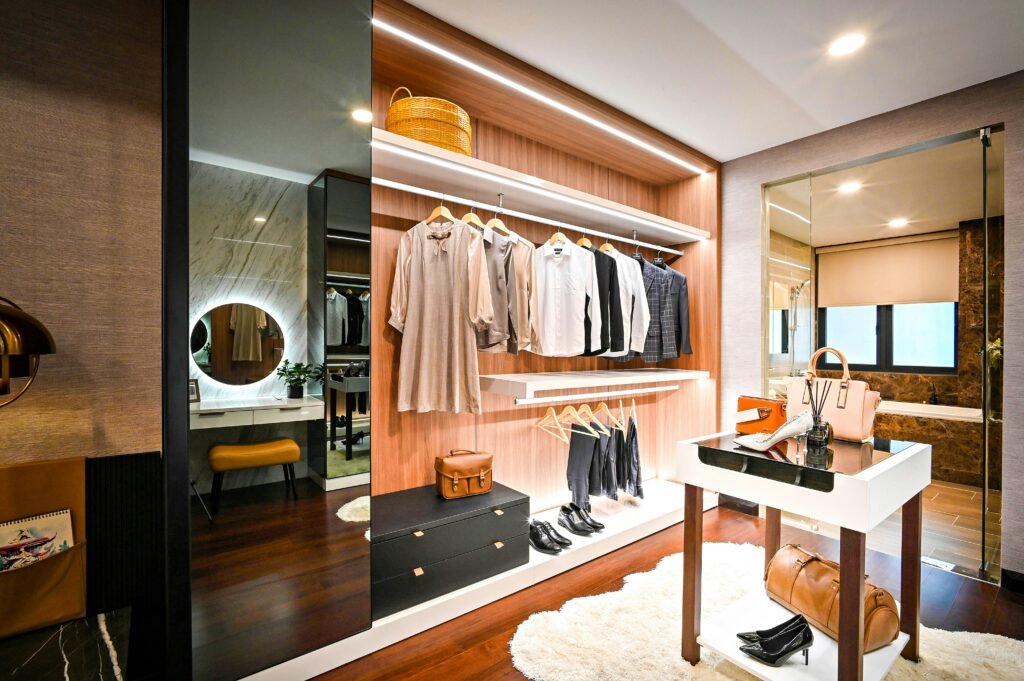
If you want your closet to look like a high-end boutique, you need to rethink how you hang your clothes. The way you arrange your hanging items dictates the entire visual flow of the space.
Standardize Your Hangers
This is the oldest trick in the professional organizing playbook, and for good reason. Mismatched plastic, wire, and wooden hangers create visual noise and take up unnecessary space.
Essense Hill strongly recommends switching to “huggable” velvet hangers. They are incredibly slim, which means you can fit significantly more clothing on a single rod. The velvet texture also prevents delicate items from slipping off and ending up in a crumpled pile on the floor.
The Color and Category Rule
Once you have matching hangers, you need a system for arranging the clothes. The gold standard for a boutique-style bedroom closet organization system is to organize by category, and then by color within that category.
Group all of your short-sleeve tops together, all of your long-sleeve tops together, all of your pants together, and so on. Then, within the short-sleeve top section, arrange the items by color, typically following the rainbow (ROYGBIV) beginning with light colors and ending with dark colors.
“If you’re looking for something black, you know exactly where to find it. It simplifies everything,”
If organizing by color feels too rigid, you can organize by lifestyle instead. If you have a strict work wardrobe and a separate casual weekend wardrobe, create two distinct zones in your closet. This makes getting dressed for the office much faster because you aren’t sifting through weekend t-shirts to find a blazer.
To Hang or to Fold?
A common question in bedroom closet organization is deciding what should be hung and what should be folded.
The standard rule is to hang whenever you can hang, and know when to fold. People often hesitate to hang heavy sweaters because they worry the hanger will stretch the shoulders. However, high-quality velvet hangers are usually gentle enough for most knits. If you have the hanging space, use it. Only when you run out of hanging room should you start folding your everyday tops and sweaters.
Organizing Shoes, Bags, and Accessories
The clothes are only half the battle. Shoes, handbags, and accessories are usually the items that cause the most clutter on the floor and shelves of a bedroom closet.
The Clear Shoe Box Strategy
Throwing shoes into a dark pile on the floor of your closet is the fastest way to ruin them. The absolute best way to store shoes is in clear, stackable drop-front shoe boxes.
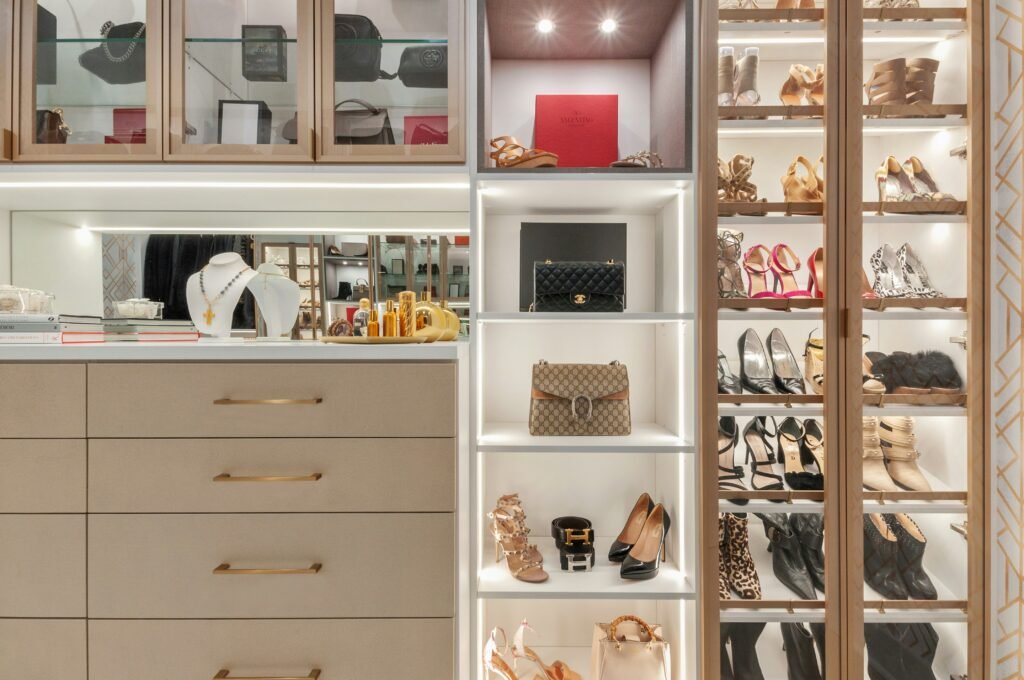
These boxes protect your shoes against dust while allowing you to see exactly what is inside. Because they are uniform in size, they stack perfectly, allowing you to build a custom “shoe wall” that utilizes the vertical space under your hanging clothes or on top of a high shelf. For taller boots or shoes that don’t fit in standard boxes, display them individually on a shelf or use clear acrylic risers to create a tiered, boutique-style look.
Displaying Handbags
Handbags are often expensive investments, yet they get shoved onto a top shelf where they lose their shape. When it comes to handbags, you should always put them on display.
“The more you see them, the more you use them. That’s the whole point—you bought them to wear them,”
Store handbags upright on your closet shelves. To keep them from falling over, use clear acrylic shelf dividers. If you want to protect high-end bags against dust while keeping them visible, clear acrylic display boxes are an excellent solution.
Taming Belts, Ties, and Hats
Belts and ties should always be hung. A dedicated tie organizer or belt rack placed in the same section as your suits and blazers makes the most sense. It mimics a retail environment. When everything is categorized together, it is much easier to pull an outfit together quickly.
Hats can be incredibly frustrating to store because they take up so much room and lose their shape if crushed. A “hat wall” is a fantastic solution. By using simple hooks to hang your hats on a blank wall in your bedroom or inside a walk-in closet, you turn a storage problem into a stylish statement piece.
Drawer Organization for Jewelry
Over-the-door jewelry organizers might seem like a good idea, but they are rarely used consistently. Most people will not take the time to unhook a necklace or carefully place earrings into a tiny pouch at the end of a long day.
Instead, organize jewelry inside shallow drawers using velvet compartment trays or acrylic inserts. This allows you to simply open the drawer, drop your rings in one section and your watch in another, and close it. Everything stays protected, categorized, and out of sight.
Bedroom Closet Renovation Ideas
Sometimes, no amount of decluttering and velvet hangers can fix a fundamentally flawed closet layout. If your closet is simply too small or poorly designed, a custom closet renovation might be the best path forward.
A closet renovation can be designed and built into life-changing organizational tools. With the help of a general contractor or designer, smaller closets can be combined to make one large one, or dead wall space can be transformed into highly functional storage.
Here are a few closet renovation ideas that can completely change your bedroom:
Combining Small Closets
In older homes and apartments, it is common to find two or three very small, narrow closets lining a bedroom wall. These are notoriously difficult to organize.
A popular renovation strategy is to demolish the walls separating these small closets to create one large, cohesive reach-in or walk-in closet. By taking down the partition walls, you regain the “dead space” between the studs, significantly increasing your usable storage area.
Adding Custom Drawers and Built-Ins
Standard builder-grade closets usually consist of a single wire shelf and one hanging rod. This leaves massive amounts of wasted space above the shelf and below the hanging clothes.
Installing a custom closet system with built-in drawers, adjustable shelving, and double-hang rods maximizes every square inch. For example, if you have a massive shoe collection, you can have a custom closet designed with pull-out drawers specifically sized for your footwear, keeping them hidden behind sleek panel doors.
The Hidden Walk-In Effect
If you have a large bedroom but a tiny closet, you can create the illusion of a walk-in closet without actually building a new room.
You can build a large, wall-to-wall closet system along one side of the bedroom, and then construct a “floating wall” a few feet in front of it. The floating wall separates the closet area from the sleeping area, giving the feeling of a luxurious walk-in closet while still allowing the space between the wall and the closet to be used as a walkway.
Framing IKEA Systems
Custom closet builds can be expensive, with high-end walk-in renovations costing $4,000 or more. If you want the custom look on a budget, you can use modular systems like the IKEA PAX.
To make these modular systems look expensive and built-in, a contractor can frame the IKEA boxes with custom trim and baseboards to seamlessly integrate them into the room’s architecture. Adding motion-sensor LED lighting and upgraded brass hardware provides a final, refined touch that mimics a high-end custom build.
Best Products for Bedroom Closet Organization
If you are ready to tackle your bedroom closet organization, having the right tools makes all the difference. Here are the products that consistently earn their keep:
| Product Type | Best Use Case | Why It Works |
| Slim Velvet Hangers | Everyday tops, pants, and dresses | Prevents slipping and doubles hanging capacity compared to plastic hangers. |
| Clear Drop-Front Shoe Boxes | Sneakers, heels, and flats | Protects shoes against dust while keeping them fully visible and easily accessible. |
| Acrylic Shelf Dividers | Sweaters, jeans, and handbags | Keeps tall stacks of folded clothes and prevents them toppling over, and holds handbags upright. |
| Velvet Drawer Trays | Jewelry, watches, and sunglasses | Prevents delicate items from scratching and keeps small accessories categorized. |
| Woven Baskets | Out-of-season clothing and swimsuits | Hides visual clutter on top shelves while adding a warm, textured design element. |
| Expandable Drawer Dividers | Underwear, socks, and folded t-shirts | Creates custom compartments within wide dresser drawers to keep folded rows neat. |
Maintaining Your Organized Closet
The final step in bedroom closet organization is maintenance. A beautifully organized closet will quickly revert to chaos if you do not have systems in place to keep it tidy.
First, adopt the “one-in, one-out” rule. For every new piece of clothing or pair of shoes you bring into the house, an older item must be donated or sold. This prevents the closet from slowly overfilling over time.
Second, keep a dedicated donation bin in the bottom of your closet. When you try on a shirt and realize it no longer fits or you simply don’t like it anymore, immediately drop it into the donation bin. Do not hang it back up. When the bin is full, take it straight to the donation center.
Finally, do a quick five-minute reset every Sunday evening. Re-hang any clothes that were tossed on a chair, put your shoes back in their boxes, and make sure your hampers are empty. By dedicating just a few minutes a week to maintenance, your bedroom closet will remain the peaceful, organized space you deserve.